Piracy

Police Complaint Removes Pirate Bay Proxy Portal From GitHub (torrentfreak.com) 32

An anonymous reader quotes a report from TorrentFreak: GitHub has taken down a popular Pirate Bay proxy information portal from Github.io. The developer platform took action in response to a takedown request sent by City of London Police's Intellectual Property Crime Unit (PIPCU). The takedown notice concludes that the site, which did not link to any infringing content directly, is illegal. [...] "This site is in breach of UK law, namely Copyright, Design & Patents Act 1988, Offences under the Fraud Act 2006 and Conspiracy to Defraud," PIPCU writes. "Suspension of the domain(s) is intended to prevent further crime. Where possible we request that domain suspension(s) are made within 48 hours of receipt of this Alert," the notice adds. This takedown request was honored by GitHub, meaning that people who try to access the domain now get a 404 error instead.

While GitHub's swift response is understandable, it's worth pointing out how these blocking efforts are evolving and expanding, far beyond blocking the original Pirate Bay site. The Proxy Bay doesn't link to infringing content directly. The site links to other proxy sites which serve up the Pirate Bay homepage. From there, users may search for or browse torrent links that, once loaded, can download infringing content. Does this mean that simply linking to The Pirate Bay can be considered a crime in itself? If that's the case, other sites such as Wikipedia and Bing are in trouble too.

A more reasonable middle ground would be to consider the intent of a site. The Proxy Bay was launched to facilitate access to The Pirate Bay, which makes court orders less effective. In 2015 UK ISPs began blocking proxy and proxy indexing sites, so that explains why thepirateproxybay.com and others are regularly blocked. Whether this constitutes criminal activity is ultimately for the court to decide, not the police. In this regard, it's worth noting that City of London Police previously arrested the alleged operator of a range of torrent site proxies. The then 20-year-old defendant, who also developed censorship circumvention tool Immunicity, was threatened with a hefty prison sentence but the court disagreed and dismissed the case.

Patents

Apple Watch Patent Infringement Confirmed, As Masimo Seeks Import Ban (9to5mac.com) 36

An anonymous reader quotes a report from 9to5Mac: Apple has suffered a setback in its long-running Apple Watch patent infringement battle with medical technology company Masimo. A court has ruled that Apple has indeed infringed one of Masimo's patents in the Apple Watch Series 6 and up. Masimi is seeking a US import on all current Apple Watches. If granted, this would effectively end Apple Watch sales in the US, as the company would not be allowed to bring in the devices from China.

The battle between the two companies has a long history. Back in 2013, Apple reportedly contacted Masimo to discuss a potential collaboration between the two companies. Instead, claims Masimo, Apple used the meetings to identify staff it wanted to poach. Masimo later called the meetings a "targeted effort to obtain information and expertise." Apple did indeed hire a number of Masimo staff, including the company's chief medical officer, ahead of the launch of the Apple Watch. Masimo CEO Joe Kiano later expressed concern that Apple may have been trying to steal the company's blood oxygen sensor technology. The company describes itself as "the inventors of modern pulse oximeters," and its tech is used in many hospitals.

In 2020, the company sued Apple for stealing trade secrets and infringing 10 Masimo patents. The lawsuit asked for an injunction on the sale of the Apple Watch. Apple has consistently denied the claims, and recently hit back with a counterclaim of its own, alleging that Masimo's own W1 Advanced Health Tracking Watch infringes multiple Apple patents. Reuters reports that a US court has ruled against Apple on one of the patent claims.

DRM

'Metropolis', Sherlock Holmes Finally Enter the Public Domain 95 Years Later (duke.edu) 87

Guess what's finally entering America's public domain today? Appropriately enough, it's Marcel Proust's 1927 novel Remembrance of Things Past.

Also entering the public domain today are thousands of other books, plus the music and lyrics of hundreds of songs, and even several silent movies.

Fritz Lang's sci-fi classic Metropolis enters the public domain today — and so does the Laurel & Hardy comedy Battle of the Century (which culminates with one of Hollywod's first pie fights), according to Duke University's Center for the Study of the Public Domain: This is actually the second time that Metropolis has gone into the US public domain. The first was in 1955, when its initial 28-year term expired and the rights holders did not renew the copyright. Then in 1996 a new law restored the copyrights in qualifying foreign works. Metropolis, along with thousands of other works, was pulled out of the public domain, and now reenters it after the expiration of the 95-year term, with the once missing scenes available for anyone to reuse.
They also note that some material is in the public domain from the beginning, including government works like the images from the James Webb telescope.

But for other works, today is a big and important day, writes the Associated Press: Alongside the short-story collection "The Case-Book of Sherlock Holmes," books such as Virginia Woolf's "To The Lighthouse," Ernest Hemingway's "Men Without Women," William Faulkner's "Mosquitoes" and Agatha Christie's "The Big Four" — an Hercule Poirot mystery — will become public domain as the calendar turns to 2023. Once a work enters the public domain it can legally be shared, performed, reused, repurposed or sampled without permission or cost.

The works from 1927 were originally supposed to be copyrighted for 75 years, but the 1998 Copyright Term Extension Act delayed opening them up for an additional 20 years. While many prominent works on the list used those extra two decades to earn their copyright holders good money, a Duke University expert says the copyright protections also applied to "all of the works whose commercial viability had long subsided."

"For the vast majority — probably 99% — of works from 1927, no copyright holder financially benefited from continued copyright. Yet they remained off limits, for no good reason," Jennifer Jenkins, director of Duke's Center for the Study of the Public Domain, wrote in a blog post heralding "Public Domain Day 2023." That long U.S. copyright period meant many works that would now become available have long since been lost, because they were not profitable to maintain by the legal owners, but couldn't be used by others. On the Duke list are such "lost" films like Victor Fleming's "The Way of All Flesh" and Tod Browning's "London After Midnight...."

Also entering the public domain today:


- Willa Cather's Death Comes for the Archbishop
- A. A. Milne's Now We Are Six (illustrations by E. H. Shepard)
- Franklin W. Dixon's The Tower Treasure — the first Hardy Boys book
- Herman Hesse's Steppenwolf (German version)
- The song "My Blue Heaven"
- Songs by Duke Ellington and Louis Armstrong
- Alfred Hitchcock's early silent movie The Lodger


The UK-based newspaper the Observer adds: For those readers who do not reside in the US, there is perhaps another reason for celebrating today, because copyright terms are longer in the US than they are in other parts of the world, including the EU and the UK. And therein lies a story about intellectual property laws and the power of political lobbying in a so-called liberal democracy.... The term was gradually lengthened in small increments by Congress until 1976, when it was extended by 19 years to 75 years and then in 1998 by the Sonny Bono Act. So, as the legal scholar Lawrence Lessig puts it, "in the 20 years after the Sonny Bono Act, while 1 million patents will pass into the public domain, zero copyrights will pass into the public domain by virtue of the expiration of a copyright term"....

[T]he end result is that American citizens have had to wait two decades to be free to adapt and reuse works to which we Europeans have had easy access....

The issue highlighted by Public Domain Day is not that intellectual property is evil but that aspects of it — especially copyright — have been monopolised and weaponised by corporate interests and that legislators have been supine in the face of their lobbying. Authors and inventors need protection against being ripped off. It's obviously important that clever people are rewarded for their creativity and the patent system does that quite well. But if a patent only lasts for 20 years, why on earth should copyright last for life plus 70 years for a novel?

Intel

Intel Settles To Escape $4 Billion Patent Suit with VLSI (theregister.com) 11

Intel and SoftBank-backed VLSI Technology have agreed to end a $4 billion patent dispute, according to documents filed in Delaware District Court this week. From a report: The decision marks a victory for Intel, which has already lost $3 billion in failed patent disputes to VLSI over the past few years. The case in question dates back to 2018 and alleged that Intel had infringed on five VLSI-owned patents governing things like secure communications, power optimization and delivery, and flip-chip interconnects.

If VLSI sounds familiar, that's because the company has been lurking around the semiconductor industry in one shape or form since the late '70s. The company originally made ASICs before it was acquired by Philips Electronics and later spun off under NXP. But despite any early successes in chipmaking, VLSI is now owned by SoftBank's Fortress Investment Group, and appears to exist solely to sue chipmakers it believes have violated its intellectual property -- in other words, it's a patent troll. The decision to call it quits comes after nearly five years of litigation. Tuesday, Intel and VLSI released a joint filing in which Intel and VLSI mutually agreed to dismiss the case and resolve all disputes over Intel's use of the aforementioned patents. Critically, VLSI has done so with prejudice. As we understand it, this means the company can't refile the case.

Patents

23 Years Ago, Amazon Gave Barnes & Noble a 1-Click Patent Lawsuit For Xmas (aboutamazon.com) 54

Long-time Slashdot reader theodp writes: In recognition of the innovation and unique nature of 1-Click, the U.S. Patent Office awarded Patent No. 5960411 to Amazon.com for 1-Click on September 28, 1999," boasted an Oct. 1999 Amazon press release. "First made available to Amazon.com customers in September 1997, 1-Click combines with Gift-Click and Wish List to make Amazon.com the most convenient, easiest-to-use shopping destination this holiday season."

The following day, Amazon weaponized its new patent, filing a lawsuit on Oct. 20th saying defendant and competitor Barnes and Noble had illegally copied Amazon's patented 1-Click ordering technology. "We're pleased that Judge Pechman recognized the innovation underlying our 1-Click feature," said Amazon CEO and 1-Click co-inventor Jeff Bezos in a Dec. 1999 Amazon press release celebrating a preliminary injunction that barred barnesandnoble.com from using its 'copycat version of 1-Click technology' while the lawsuit was pending (Amazon and B&N settled in 2002).

"The patent system is designed to encourage innovation on behalf of customers," Amazon had written in its 1999 press release, arguing that in 1997 its 1-Click technology "was a significant step forward for online shoppers that required thousands of hours of effort." It's been noted that B&N first threw down the litigation gauntlet, slapping Amazon with a lawsuit over its marketing claim as "World's Largest Bookstore" just days before Amazon's IPO in May 1997.

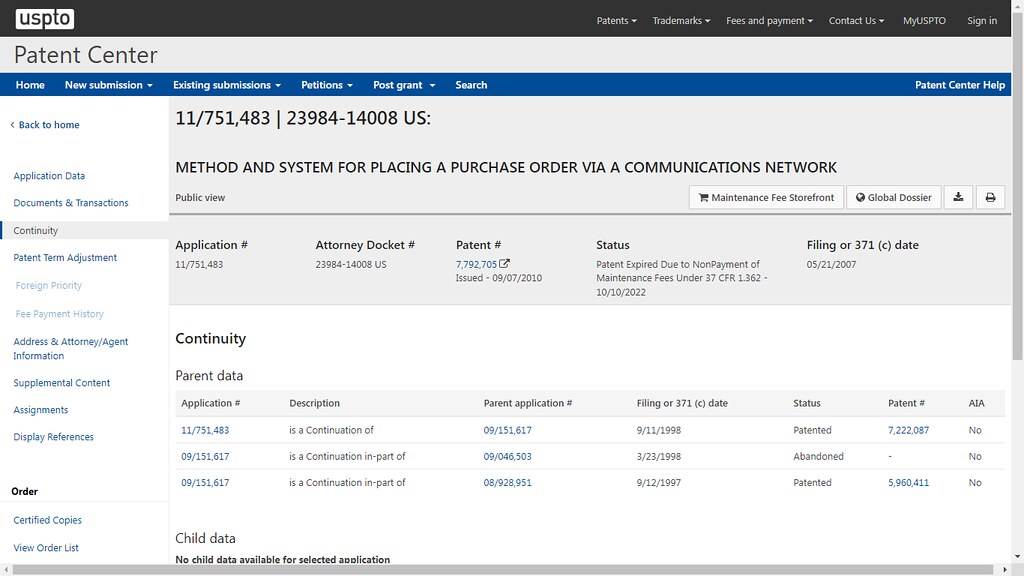
USPTO continuity records show a 'child' patent of the original Method and System for Placing a Purchase Order Via a Communications Network patent finally expired due to non-payment of maintenance fees on 10/10/2022, more than 25 years after Amazon applied for its 1-Click patent on 9/22/1997.

Google

How an Unlikely Subpoena to Google Helped Solve a Complex International Missing Person Case (andrewwatters.com) 46

Long-time Slashdot reader wattersa is a lawyer in Redwood City, California, "and a Slashdot reader since 1998.

"I recently concluded a three-year missing person investigation that unfortunately turned into an overseas homicide in Taiwan. I was authorized by my client to publish the case study on my website, which is based on our recent court filings..." And yes, he writes that the case was solved with a subpoena to Google: I filed that case in late 2019 and then used the subpoena power to try to solve the disappearance, which seemed appropriate. We solved the case in late 2020 due to a fake "proof of life" email that the suspect sent from the victim's email account, which he sent from a hotel where he testified he was staying alone on the night of the disappearance — after (according to him) dropping off the victim at the local train station. The victim could not have sent the email from the other side of Taiwan, which is where the email indicated it was from.... The suspect in my case is a Tony Stark-level supergenius with a Ph.D. and dozens of patents, who works at a prominent engineering company in California. He is currently wanted in Taiwan.

The case was solved with a subpoena to Google for the login/logout history of the victim's Gmail account and the originating IP address of the proof of life email. Although Google does not include the originating IP address in the email headers, it turns out that they retain the IP address for some unknown length of time and we were able to get it. When it became clear that this case was a homicide, co-counsel and I dismissed the conservatorship case and filed a wrongful death case against the suspect in 2021.

We continue to gather information through subpoenas, depositions, and interviews, all of which show that the victim died in a 10-hour window on November 29, 2019. The wrongful death case goes to trial in late 2023 in Santa Clara County. This is a rare case in which the family can afford an expensive, lengthy, attorney-led private investigation.

The original submission includes additional details about a rarely used statute in California that allows conservatorship of a missing person's estate — and apparently grants subpoena power. And it was in response to such a subpoena that Google produced the originating IP address of that crucial proof of life email.

"This obscure statute in the Probate Code was instrumental in solving the case because we didn't have to wait for law enforcement to take action, and we were able to aggressively pursue our own leads. This gave the family a sense of agency and closure, as well as the obvious benefit of solving the disappearance. Also, Taiwan law enforcement could not do subpoenas from Taiwan, so we ended up contributing to their investigation to some extent as well."
Patents

Apple Satellite Plans May Extend Beyond Emergencies, Suggests New Patent (9to5mac.com) 28

A new patent granted to Apple suggests the company could use satellite communications for more than just getting help in an emergency. 9to5Mac reports: Emergency SOS via Satellite was one of the headline features of September's Apple event -- so much so that the Far Out event name referenced it. The service launched in the US and Canada last month, and was yesterday extended to the UK, France, Germany, and Ireland. More countries will follow. A patent granted on the same day the service expanded to more countries suggests that Apple satellite plans may extend beyond text, and beyond emergency use.

Patently Apple spotted it: "Satellite communications data conveyed by transceivers #28 and antenna radiators #30 may include media data (e.g., streaming video, television data, satellite radio data, etc.), voice data (e.g., telephone voice data), internet data, and/or any other desired data." Apple has currently committed $450M to support the satellite communications feature, a reasonably sizeable amount of money even by Apple standards for a service that will be of use to a tiny fraction of iPhone owners. But if it's the start of something more, then the investment could look rather modest.

China

After US Sanctions, Huawei Seeks New Revenue By Licensing Its 5G Patents to Rival (cnbc.com) 15

CNBC reports: Chinese technology giant Huawei said Friday it will license its 5G technology to rival handset maker Oppo as it looks to unlock a new revenue stream after its smartphone business was crushed by U.S. sanctions....

Huawei has a massive portfolio of over 100,000 patents globally. It is one of the top patent holders in 5G technology, which is next-generation ultra-fast mobile internet seen as key to underpinning future industries such as artificial intelligence and autonomous cars.... The company previously stated that it expected to earn revenue of $1.2 billion to $1.3 billion from licensing its intellectual property between 2019 to 2021. Huawei said that it met its intellectual property revenue expectations for 2021, but did not provide a figure.

Apple

Ericsson and Apple End Patent-Related Legal Row With Licence Deal (reuters.com) 2

Ericsson said on Friday it had struck a global patent licence agreement with Apple, ending a row over royalty payments for the use of 5G wireless patents in iPhones. From a report: The Swedish telecoms equipment maker said the multi-year deal included global cross-licences for patented cellular standard-essential technologies, and granted certain other patent rights. The deal comes after Ericsson in January filed a second set of patent infringement lawsuits against the U.S. maker of iPhones. Both companies had already sued each other in the United States as negotiations failed over the renewal of a seven-year licensing contract for telecoms patents first struck in 2015. Ericsson sued first in October 2021, claiming that Apple was trying to improperly cut down the royalty rates. The iPhone maker then filed a lawsuit in December 2021, accusing the Swedish company of using "strong-arm tactics" to renew patents.
Open Source

Amazon Joins Open Invention Network (zdnet.com) 4

Amazon and Amazon Web Services (AWS) have joined the Open Invention Network (OIN) -- the world's largest patent non-aggression consortium. ZDNet reports: OIN has long protected Linux and Linux-related software from patent aggression by rival companies. With the recent increase in patent troll attacks, the OIN is also defending companies from these assaults. This is a natural move for Amazon. Besides relying on Linux and open-source software both for its retail and cloud businesses, Amazon has a strict policy against patent infringement, and users who engage in this behavior can have their listings removed or accounts deleted. Nevertheless, like all large companies, Amazon has also been sued for patent violations. Joining the OIN simply makes good business sense. Nithya Ruff, the Amazon Open Source Program Office director, added: "Linux and open source are essential to many of our customers and a key driver of innovation across Amazon. We are proud to support a broad range of open-source projects, foundations, and partners, and we are committed to the long-term success and sustainability of open source as a whole. By joining OIN, we are continuing to strengthen open source communities and helping to ensure technologies like Linux remain thriving and accessible to everyone."
Businesses

The Endless Quest For a Better Mousetrap (newyorker.com) 87

Inventors have been refining them for centuries. What are they trying to achieve? From a report: Today, there are only a few kinds of mousetraps available at a typical hardware store: snap traps, glue traps, electric traps, bucket traps, and live-capture traps. And yet, inventors have filed more than forty-five hundred U.S. patents for animal traps, about a thousand of which are specifically related to mice. (Many inventors don't specify the intended targets of their traps.) Presumably, some mousetrap inventors have been spurred on by a quote widely attributed to Ralph Waldo Emerson: "Build a better mousetrap, and the world will beat a path to your door." Emerson probably never said exactly this; what he did write down, in a journal, was that the world would beat a path to the door of anyone who sold better corn, wood, boards, pigs, chairs, knives, crucibles, or church organs. There's nothing uniquely profitable about mousetraps. Still, people keep inventing them, probably because mice are such a widespread nuisance.

Some inventors come up with mousetraps because of firsthand rodent experiences. One company well known for traps that can hold multiple mice at once, for instance, was founded by a janitor at an Iowa high school who noticed that mice were eating the students' lunches. But, just as there are too many mice, there are too many mousetraps. In a 2011 paper, Dagg, the schoolteacher, found that only four per cent of the mousetraps patented in the United States have been commercially produced -- and many designs are never even patented. The Trap History Museum, outside Columbus, Ohio, houses what is very likely the world's largest collection of mousetraps. Many of the designs on view there would be prohibitively expensive to mass-produce, given their unwieldy size or reliance on wacky technologies. Others barely work, having apparently been designed to function on only the rarest of occasions. Some designs are dreamy and imaginative; like contemporary art, they are valued for those qualities, not because they make it easier to keep a mouse-free home. You wouldn't pee in a toilet mounted on a gallery wall. Likewise, you wouldn't get much use out of a trap, patented in 1908, that affixes a jangly collar to a mouse so that it will annoy other mice until they flee their compatriot for the great outdoors.

AI

Google's Secret New Project Teaches AI To Write and Fix Code (businessinsider.com) 50

Google is working on a secretive project that uses machine learning to train code to write, fix, and update itself. From a report: This project is part of a broader push by Google into so-called generative artificial intelligence, which uses algorithms to create images, videos, code, and more. It could have profound implications for the company's future and developers who write code. The project, which began life inside Alphabet's X research unit and was codenamed Pitchfork, moved into Google's Labs group this summer, according to people familiar with the matter. By moving into Google, it signaled its increased importance to leaders. Google Labs pursues long-term bets, including projects in virtual and augmented reality.

Pitchfork is now part of a new group at Labs named the AI Developer Assistance team run by Olivia Hatalsky, a long-term X employee who worked on Google Glass and several other moonshot projects. Hatalsky, who ran Pitchfork at X, moved to Labs when it migrated this past summer. Pitchfork was built for "teaching code to write and rewrite itself," according to internal materials seen by Insider. The tool is designed to learn programming styles and write new code based on those learnings, according to people familiar with it and patents reviewed by Insider. "The team is working closely with the Research team," a Google representative said. "They're working together to explore different use cases to help developers."

Apple

Apple Lawsuits Say Health Monitoring Company Masimo Copied Apple Watch (reuters.com) 19

Apple has sued medical technology company Masimo in Delaware federal court, accusing its new W1 line of smartwatches of infringing several Apple Watch patents. From a report: The two lawsuits said Masimo copied Apple's technology while seeking bans on sales and imports of Apple Watches in earlier intellectual-property cases against the tech giant in California and at a U.S. trade tribunal. Apple said Masimo "carefully studied Apple's IP" during those cases and claimed a Masimo spinoff received confidential information about the Apple Watch. Apple accused Masimo of trying to use the litigation to remove Apple's watches from the market to "make way for Masimo's own watch." Irvine, California-based Masimo said in a statement that Apple's lawsuits are "retaliatory" and "appear to be an attempt to avoid the court in which the parties have been litigating their dispute for the past three years." Masimo, which specializes in health-monitoring devices for medical patients, sued Apple in California federal court in 2020.
Open Source

Fintech Giant 'The Clearing House' Joins Open-Source Patent Protection Powerhouse OIN (zdnet.com) 6

The Clearing House, a banking association and payments company owned by the largest commercial banks in the U.S., has joined the Open Invention Network (OIN) -- the world's largest patent nonaggression consortium. ZDNet reports: The OIN has long protected Linux and Linux-related software from patent aggression by rival companies. With the increase in patent troll attacks, the OIN is also defending companies from these assaults. You may not think financial companies and banks are subject to such attacks. I mean, TCH's roots go all the way back to 1853. Think again.

As Keith Bergelt, CEO of OIN, said in June, "The most sophisticated and compelling global banking and fintech companies have essentially become technology companies that employ open-source software to deliver their services at scale." Further, patent trolls "appear to be targeting them for this reason, along with the fact that financial services companies have not historically been active patent filers." That's because, historically, they've purchased most of their tech from third-party vendors.

That was then. This is now. Today, financial institutions generate more tech in-house, so they're more concerned about being granted patents, building patent portfolios, and related patent issues. Indeed, these days fintech businesses have their own Fintech Open Source Foundation (FINOS), the financial sector branch of the Linux Foundation. So, Bergelt said in a release Wednesday, "Advancements in financial services and fintech increasingly rely on open-source technologies. As the most experienced payment company in the US, and a keystone for the financial services industry, we are pleased that The Clearing House is committed to patent nonaggression in core Linux and adjacent open-source technologies."

The Courts

Apple Loses Second Bid To Challenge Qualcomm Patents At US Supreme Court (reuters.com) 22

The U.S. Supreme Court on Monday again declined to hear Apple's bid to revive an effort to cancel three Qualcomm smartphone patents despite the settlement of the underlying dispute between the two tech giants. Reuters reports: The justices left in place a lower court's decision against Apple after similarly turning away in June the company's appeal of a lower court ruling in a closely related case challenging two other Qualcomm patents. Qualcomm sued Apple in San Diego federal court in 2017, arguing that its iPhones, iPads and Apple Watches infringed a variety of mobile-technology patents. That case was part of a broader global dispute between the tech giants. Apple challenged the validity of the patents at issue in this case at the U.S. Patent and Trademark Office's Patent Trial and Appeal Board.

The companies settled their underlying fight in 2019, signing an agreement worth billions of dollars that let Apple continue using Qualcomm chips in iPhones. The settlement included an Apple license to thousands of Qualcomm patents, but allowed the patent-board proceedings to continue. The board upheld the patents in 2020, and Apple appealed to the patent-specialist U.S. Court of Appeals for the Federal Circuit. Cupertino, California-based Apple argued it had proper legal standing to appeal because San Diego-based Qualcomm could sue again after the license expires, potentially as soon as 2025.

A Federal Circuit three-judge panel, in a 2-1 ruling, dismissed the case last year for a lack of standing, finding that Apple's risk of being sued again was speculative and the challenge would not affect its payment obligations under the settlement. Qualcomm has again argued that Apple has not shown a concrete injury to justify the appeal, just like in the "materially identical" case that the high court rejected.

Patents

Meta Ordered To Pay $175 Million For Copying Green Beret Veteran's App (militarytimes.com) 36

Meta, the parent company of Facebook and Instagram, was found by a federal jury in Austin, Texas, to have infringed on two patents held by Voxer, a walkie talkie messaging app founded by a former Army Green Beret. The social media giant was ordered to pay nearly $175 million in damages. Military Times reports: Voxer launched the app in 2011, which was named Best Overall App in the First Annual Silicon Valley Business App Awards in 2013. In 2012, Facebook approached Voxer about a potential collaboration that led to Voxer sharing its patents and proprietary information with the company. "When early meetings did not result in an agreement, Facebook identified Voxer as a competitor although Facebook had no live video or voice product at the time," court filings read. "Facebook revoked Voxer's access to key components of the Facebook platform and launched Facebook Live in 2015 followed by Instagram Live in 2016. Both products incorporate Voxer's technologies and infringe its patents."

The Texas jury found that Facebook Live and Instagram Live incorporated two pieces of Voxer's technologies that involve streaming media over networks. Meta countered in court filings that "Facebook has prioritized live video messaging since the launch of Facebook Live and Instagram Live, with one report identifying Facebook Live as Facebook's 'top priority.'"
In a statement to TechCrunch, Meta said the social media company will continue to press the issue through the courts. "We believe the evidence at trial demonstrated that Meta did not infringe Voxer's patents," Meta's spokesperson said in the statement. "We intend to seek further relief, including filing an appeal."
Apple

Apple's Korea Offices Raided by Antitrust Regulators Over Allegations It Charges Developers 33% Commission (macrumors.com) 11

Apple's South Korean headquarters have been raided by antitrust regulators after a complaint was raised by developers that it is charging them over the standard 30% App Store commission rate. From a report: The dawn raid by the Korea Fair Trade Commission (KFTC) was reported by local media on Monday and covered on Friday by the Foss Patents blog, highlighting the ongoing investigation in the country into Apple's alleged abuse of market power. The complaint that sparked the raid was reportedly brought by mobile game developers who argued that Apple charges more than the typical 30% commission rate for purchases made in the App Store. As Foss Patents points out, Apple charges 30% of the price paid by end users, which includes value added tax (VAT), making it 10% higher than the amount on which Google bases its 30% commission, which doesn't include VAT. Apple is therefore collecting 33% (30% of 110%), not the headline 30% rate.
Patents

Coinbase Sued For Patent Infringement Over Crypto Transfer Technology (coindesk.com) 17

Coinbase is being sued by Veritaseum Capital LLC, which alleges that the crypto exchange has infringed on a patent awarded to Veritaseum founder Reggie Middleton. CoinDesk reports: According to Veritaseum, Coinbase has used the patent for some of its blockchain infrastructure, and the company is seeking at least $350 million in damages. Middleton and Veritaseum in 2019 settled a case with the U.S. Securities and Exchange Commission (SEC), paying nearly $9.5 million over charges surrounding the initial coin offering (ICO) for the company's VERI token/ "Veritaseum's website says it 'builds blockchain-based, peer-to-peer capital markets as software on a global scale,'" adds Reuters, which first reported the lawsuit. "Thursday's lawsuit accuses Coinbase features including its website, mobile app and Coinbase Cloud, Pay, and Wallet services of infringing a patent covering a secure method for processing digital-currency transactions."

"Veritaseum Capital's attorney Carl Brundidge of Brundidge Stanger said Friday that Coinbase was 'uncooperative' when they tried to settle out of court."
Google

Google Spins Out Secret Hi-Speed Telecom Project Called Aalyria (cnbc.com) 13

Inside Google, a team of techies has been working behind the scenes on software for high-speed communications networks that extend from land to space. Codenamed "Minkowski" within Google, the secret project is being unveiled to the public on Monday as a new spinout called Aalyria. CNBC reports: While Google declined to offer details about Aalyria, such as how long it's been working on the technology and how many employees are joining the startup, Aalyria said in a news release that its mission is to manage "hyper fast, ultra-secure, and highly complex communications networks that span land, sea, air, near space, and deep space." The company says it has a laser communications technology "on an exponentially greater scale and speed than anything that exists today." Aalyria's software platform has been used in multiple aerospace networking projects for Google.

Aalyria (pronounced ah-Leer-eeh-ah) said it has an $8.7 million commercial contract with the U.S. Defense Innovation Unit. The company will be led by CEO Chris Taylor, a national security expert who has led other companies that have worked with the government. Taylor's LinkedIn profile says he's the CEO of a company in stealth mode that he founded in November. Aalyria's board of advisors includes several previous Google employees and executives as well as Vint Cerf, Google's chief internet evangelist who's known as one of the fathers of the web. Google will retain a minority stake in Aalyria but declined to say how much it owns and how much outside funding the company has raised. Google said that earlier this year it transferred nearly a decade's worth of intellectual property, patents and physical assets, including office space, to Aalyria.
Aalyria's light laser technology, which it calls "Tightbeam," claims to keep data "intact through the atmosphere and weather and offers connectivity where no supporting infrastructure exists."

"Tightbeam radically improves satellite communications, Wi-Fi on planes and ships, and cellular connectivity everywhere," the company said.
Intel

Intel, Which Coined The Term 'Patent Troll', Makes Deal With Patent Troll To 'Monetize' Unused Patents (techdirt.com) 31

Mike Masnick, reporting for TechDirt: Intel recently announced that it was handing 5,000 patents off to IPValue, which (as it does in these kinds of deals) spun up a shell corporation called Tahoe Research Limited to go see who it can shake down over these patents. Usually, the way these deals work is that the company, Intel, gets some relatively modest amount of cash upfront, but also a piece of anything the troll can squeeze out of others. Considering these are basically zero value patents for Intel, the temptation must be great to at least get something out of them.

Slashdot Top Deals