Television

MTV's Music-Only Channels Go Off the Air (rollingstone.com) 51

An anonymous reader shares a report: MTV shut down many of its last dedicated 24-hour music channels Dec. 31. The move, announced back in October, affected channels around the world, with the U.K. seeing five different MTV stations going dark. These include MTV Music, MTV 80s, MTV 90s, Club MTV, and MTV Live. As Consequence notes, MTV Music -- which launched in 2011 -- notably ended its run by airing the Buggles' "Video Killed the Radio Star," the first visual to air when MTV launched in the United States in 1981.

MTV's parent company, Paramount Skydance, is also expected to shutter music-only channels in Australia, Poland, France, and Brazil. Despite axing much of its dedicated music programming, MTV's flagship channels are still expected to keep broadcasting in the U.K. and elsewhere. Like in the U.S., these channels primarily air massively popular reality programs, as opposed to music videos.

Movies

Slashdot Asks: Your Favorite 2025 Movies, TV Shows and Books? 46

Another year wraps up, and with it comes the annual ritual of taking stock. What were the movies, TV shows and books from this year that stood out to you? Not necessarily the ones that dominated conversation or topped charts, but the ones you found yourself recommending to friends, or returning to for a second watch or read.

Share your picks and, if you're inclined, a line or two on what made them stick.
AI

'2025 Was the Year of Creative Bankruptcy' 23

PC Gamer argues that 2025 was a year full of high-profile AI embarrassments across games and entertainment, with Disney and Lucasfilm serving as the "opening salvo." From the report: At a TED talk back in April, Lucasfilm senior vice president of creative innovation Rob Bredow presented a demonstration of what he called "a new era of technology." Across 50 years of legendary innovation in miniature design, practical effects, and computer animation, Lucasfilm and its miracle workers at Industrial Light & Magic have blazed the trail for visual effects in creative storytelling -- and now Bredow was offering a glimpse at what wonders might come next.

That glimpse, created over two weeks by an ILM artist, was Star Wars: Field Guide: a two-minute fizzle reel of AI-generated blue lions, tentacled walruses, turtles with alligator heads, and zebra-stripe chimpanzees, all lazily spliced together from the shuffled bits of normal-ass animals. These "aliens" were less Star Wars than they were Barnum & Bailey. It felt like a singular embarrassment: Instead of showing its potential, generative AI just demonstrated how out of touch a major media force had become. And then it kept happening.

At the time, I wondered whether evoking the legacy of Lucasfilm just to declare creative bankruptcy had provoked enough disgusted responses to convince Disney to slow its roll on AI ventures. In the months since, however, it's clear that Star Wars: Field Guide wasn't a cautionary tale. It was a mission statement. Disney is boldly, firmly placing its hand on the hot stove.
Other embarrassing AI use cases include Fortnite's AI-powered Darth Vader NPC, Activision's use of AI-generated art in what was widely described as the "weakest" Call of Duty launch in years, McDonald's short-lived AI holiday ad, and Disney's $1 billion licensing deal with OpenAI.
Television

Americans Are Watching Fewer New TV Shows and More Free TV (bloomberg.com) 71

Americans are settling into streaming habits that should worry Hollywood executives, as new Nielsen data analyzed by Bloomberg reveals that not a single new original series cracked the top 10 most-watched streaming shows in 2025 -- the first time this has happened since Nielsen began publishing streaming data in 2020.

The shift extends beyond original programming as free, ad-supported streaming services are growing faster than their paid counterparts. YouTube has become the most-watched streaming service on American televisions, now larger than Netflix and Amazon combined. The Roku Channel and Tubi have nearly doubled in size over the past two years, while Peacock and Warner Bros.' streaming services have stagnated at roughly half their free competitors' viewership share.

Netflix still dominates when it comes to hits, accounting for about two-thirds of original programs appearing in Nielsen's weekly top 10 lists. But that dominance is eroding -- the company's share of streaming viewership has fallen below 20%. Meanwhile, Disney's streaming services haven't increased their share of TV viewing in three years, and Amazon is closing in. The most-watched original series of 2025 was Squid Game's final season, followed by returning shows Wednesday and Love Island.
Movies

'No Happy Ending for Movie Theatres', Argues WSJ - No Matter Who Wins Warner Bros. (msn.com) 74

Regardless of who ends up owning Warners Bros., "the outlook for theatrical movies is dimming," writes a Wall Street Journal tech columnist, noting that this year's U.S. box office of $8.3 billion (as of December 25) "is a bit below last year's and well below prepandemic levels of around $11 billion." Warner has historically been one of Hollywood's largest producers of theatrical films, averaging about 22 releases annually in the pre-Covid years of 2015 to 2019, according to data from Comscore. Its franchises include "Harry Potter," the DC Comics characters and "Lord of the Rings." But the current bidding war between Netflix and Paramount Skydance means Warner's future will ultimately be in the hands of either a streaming giant with a longstanding distaste for movie theaters, or a rival studio that will carry a sky-high debt load and therefore a need to sharply cut costs... [Though later the article cites a Wedbush analyst's observation that the current theatrical slate has already been negotiated through 2029, "so any buyer would have to honor those contracts" with theatrical releases for Warner films "for at least the next four years."]

Investors seem deeply skeptical. Cinemark shares have shed about 18% of their value over the past month, while rival exhibitor AMC Entertainment is down more than 30%. Morgan Stanley recently downgraded Cinemark to a neutral rating, with analyst Ben Swinburne noting that concern over Netflix's commitment to theatrical distribution and release windows "is likely to cap the multiple" on Cinemark's stock.... [T]ime hasn't been on the side of movie theaters for a while now, and a takeover of Warner Bros. won't turn back that clock.

AI

Did Tim Cook Post AI Slop in His Christmas Message Promoting 'Pluribus'? (daringfireball.net) 23

Artist Keith Thomson is a modern (and whimsical) Edward Hopper. And Apple TV says he created the "festive artwork" shared on X by Apple CEO Tim Cook on Christmas Eve, "made on MacBook Pro."

Its intentionally-off picture of milk and cookies was meant to tease the season finale of Pluribus. ("Merry Christmas Eve, Carol..." Cook had posted.)

But others were convinced that the weird image was AI-generated.

Tech blogger John Gruber was blunt. "Tim Cook posts AI Slop in Christmas message on Twitter/X, ostensibly to promote 'Pluribus'." As for sloppy details, the carton is labeled both "Whole Milk" and "Lowfat Milk", and the "Cow Fun Puzzle" maze is just goofily wrong. (I can't recall ever seeing a puzzle of any kind on a milk carton, because they're waxy and hard to write on. It's like a conflation of milk cartons and cereal boxes.)
Tech author Ben Kamens — who just days earlier had blogged about generating mazes with AI — said the image showed the "specific quirks" of generative AI mazes (including the way the maze couldn't be solved, expect by going around the maze altogether). Former Google Ventures partner M.G. Siegler even wondered if AI use intentionally echoed the themes of Pluribus — e.g., the creepiness of a collective intelligence — since otherwise "this seems far too obvious to be a mistake/blunder on Apple's part." (Someone on Reddit pointed out that in Pluribus's dystopian world, milk plays a key role — and the open spout of the "natural" milk's carton does touch a suspiciously-shining light on the Christmas tree...)

Slashdot contacted artist Keith Thomson to try to ascertain what happened...
Media

'Why I Quit Streaming And Got Back Into Cassettes' (404media.co) 144

"In the age of Spotify and AI slop, tapes remind us what we're missing when we stop taking risks," writes author Janus Rose in an article for 404 Media. Here's an excerpt: There are lots of advantages to the cassette lifestyle. Unlike vinyl records, tapes are compact and super-portable, and unlike streaming, you never have to worry about a giant company suddenly taking them away from you. They can be easily duplicated, shared, and made into mixtapes using equipment you find in a junk shop. When I was a kid, the first music I ever owned were tapes I recorded from MTV with a Kids' Fisher Price tape recorder. I had no money, so I would listen to those tapes for hours, relishing every word Kim Gordon exhaled on my bootlegged copy of Sonic Youth's "Bull in the Heather." Just like back then, my rediscovery of cassettes has led me to start listening more intentionally and deeply, devoting more and more time to each record without the compulsion to hit "skip." Most of the cassettes I bought in Tokyo had music I probably never would have found or spent time with otherwise.

Getting reacquainted with tapes made me realize how much has been lost in the streaming era. Over the past two decades, platforms like Spotify co-opted the model of peer-to-peer filesharing pioneered by Napster and BitTorrent into a fully captured ecosystem. But instead of sharing, this ecosystem was designed around screen addiction, surveillance, and instant gratification -- with corporate middlemen and big labels reaping all the profits. Streaming seeks to virtually eliminate what techies like to call "user friction," turning all creative works into a seamless and unlimited flow of data, pouring out of our devices like water from a digital faucet. Everything becomes "Content," flattened into aesthetic buckets and laser-targeted by "perfect fit" algorithms to feed our addictive impulses. Thus the act of listening to music is transformed from a practice of discovery and communication to a hyper-personalized mood board of machine-optimized "vibes."

What we now call "AI Slop" is just a novel and more cynically efficient vessel for this same process. Slop removes human beings as both author and subject, reducing us to raw impulses -- a digital lubricant for maximizing viral throughput. Whether we love or hate AI Slop is irrelevant, because human consumers are not its intended beneficiaries. In the minds of CEOs like OpenAI's Sam Altman, we're simply components in a machine built to maintain and accelerate information flows, in order to create value for an insatiably wealthy investor class. [...]

Tapes and other physical media aren't a magic miracle cure for late-stage capitalism. But they can help us slow down and remember what makes us human. Tapes make music-listening into an intentional practice that encourages us to spend time connecting with the art, instead of frantically vibe-surfing for something that suits our mood from moment-to-moment. They reject the idea that the point of discovering and listening to music is finding the optimal collection of stimuli to produce good brain chemicals. More importantly, physical media reminds us that nothing good is possible if we refuse to take risks. You might find the most mediocre indie band imaginable. Or you might discover something that changes you forever. Nothing will happen if you play it safe and outsource all of your experiences to a content machine designed to make rich people richer.

Music

Spotify Disables Accounts After Open-Source Group Scrapes 86 Million Songs From Platform (therecord.media) 27

After Anna's Archive published a massive scrape containing 86 million songs and metadata from Spotify, the streaming giant responded by disabling the nefarious accounts responsible. A spokesperson for Spotify told Recorded Future News that it "has identified and disabled the nefarious user accounts that engaged in unlawful scraping."

"We've implemented new safeguards for these types of anti-copyright attacks and are actively monitoring for suspicious behavior," the spokesperson said. "Since day one, we have stood with the artist community against piracy, and we are actively working with our industry partners to protect creators and defend their rights." The Record reports: The spokesperson added that Anna's Archive did not contact them before publishing the files. They also said it did not consider the incident a "hack" of Spotify. The people behind the leaked database systematically violated Spotify's terms by stream-ripping some of the music from the platform over a period of months, a spokesperson said. They did this through user accounts set up by a third party and not by accessing Spotify's business systems, they added.

Anna's Archive published a blog post about the cache this weekend, writing that while it typically focuses its efforts on text, its mission to preserve humanity's knowledge and culture "doesn't distinguish among media types." "Sometimes an opportunity comes along outside of text. This is such a case. A while ago, we discovered a way to scrape Spotify at scale. We saw a role for us here to build a music archive primarily aimed at preservation," they said. "This Spotify scrape is our humble attempt to start such a 'preservation archive' for music. Of course Spotify doesn't have all the music in the world, but it's a great start."

Movies

What Rules Govern Hallmark Christmas Movies? (stephenfollows.com) 42

Hallmark has released more than 300 Christmas-themed TV movies since 2000, and a detailed internal rulebook obtained by film data analyst Stephen Follows explains how the company manages to produce nearly one new holiday film per week during the final quarter of each year without the whole operation collapsing into creative chaos.

The document, referred to as Hallmark's "bible" by writers and producers who have worked on these films, specifies everything from script length (105-110 pages across a rigid nine-act structure) to prohibited activities (no bowling, no karaoke). Christmas movies must include snow or its remnants and feature characters engaged in seasonal activities like baking cookies, ice skating, and drinking hot chocolate.

The target demographic is women aged 25-54, and the content must be watchable by an 80-year-old grandmother and a 5-year-old niece simultaneously. The economics differ sharply from theatrical filmmaking. Licensed titles from outside production companies carry budgets around $500,000 or less, while Hallmark's in-house productions can exceed $2 million. About three-quarters of the library comes from external producers. The formula appears to work. Hallmark TV movies have averaged a 6.3 IMDb user score over the past 14 years, compared to 5.9 for feature films worldwide.

Further reading: Using Data To Determine if 'Die Hard' is a Christmas Movie.
Youtube

YouTube Has a Firm Grip on Daytime TV (nytimes.com) 34

YouTube has been winning the streaming wars for years, but its real competitive advantage comes not from prime-time viewing but from its stranglehold on daytime hours when Americans are meditating, exercising, cooking, or simply looking for background noise. At 11 a.m. in October, YouTube commanded an average audience of 6.3 million viewers compared to Netflix's 2.8 million, according to Nielsen data. Amazon drew about a million viewers at that hour, and HBO Max, Paramount+ and Peacock each pulled fewer than 600,000.

The gap narrows significantly at night -- Netflix's audience swells to over 11 million at 9 p.m., trailing YouTube's 12 million -- but YouTube's dominance reasserts itself in overnight hours and through the next day. Netflix is responding by bringing at least 34 video podcasts to its service next year, including "The Breakfast Club," "The Bill Simmons Podcast," and "Pardon My Take." Amazon added the Kelce brothers' "New Heights" podcast to Prime Video in September. The strategy is intentional: roughly 75 percent of all podcast listening happens between 6 a.m. and 6 p.m., according to Edison Research. YouTube said viewers watched 700 million hours of video podcasts on living room devices in October alone, a 75% increase from the previous year.
Television

Samsung's 2026 Gaming Monitors Promise 6K, 3D, and Up To 1,040Hz (theverge.com) 44

An anonymous reader shares a report: Samsung is breaking new ground with its 2026 lineup of gaming monitors, with the Odyssey 3D G90XH becoming the first to feature a 6K display with "glasses-free 3D." The new monitor comes with a 32-inch IPS panel, offering real-time eye-tracking that "adjusts depth and perspective" based on your position, along with a speedy 165Hz refresh rate that you can boost to 330Hz with a Dual Mode feature that switches to 3K.

[...] A 6K 3D display isn't the only notable upgrade coming to Samsung's lineup; the company is launching the Odyssey G6 G60H, which it says is the "world's first" 1,040Hz gaming monitor. The 27-inch monitor only supports this ultra-fast refresh rate in HD, while its native 1440p resolution still offers speeds up to a very fast 600Hz. It's also compatible with AMD FreeSync Premium and NVIDIA G-Sync.

Movies

Why Some Avatar: Fire and Ash Scenes Look So Smooth, and Others Don't (gamesradar.com) 62

If you watched Avatar: Fire and Ash in James Cameron's preferred high frame rate 3D format and noticed certain sequences appearing unusually smooth while others had the traditional cinematic look, that visual inconsistency is entirely intentional. The third Avatar film continues Cameron's frame rate experimentation from The Way of Water, selectively deploying 48 frames per second for underwater and flying sequences while keeping dialogue scenes at the standard 24 FPS.

The human eye perceives somewhere between 30 and 60 FPS, meaning viewers can detect the shift between frame rates. Cameron argues the tradeoff is worth it: discomfort from 3D viewing isn't eye strain but "brain strain," caused when parallax-sensitive neurons struggle to process jumping vertical edges. Higher frame rates smooth this out. When critics questioned the approach, Cameron was characteristically blunt. "I think $2.3 billion says you might be wrong on that," he told DiscussingFilm, referencing The Way of Water's box office.
Music

Spotify Says 'Anti-Copyright Extremists' Scraped Its Library (musically.com) 59

A group of activists has scraped Spotify's entire library, accessing 256 million rows of track metadata and 86 million audio files totaling roughly 300TB of data. The metadata has been released via Anna's Archive, a search engine for "shadow libraries" that previously focused on books.

Spotify described the activists as "anti-copyright extremists who've previously pirated content from YouTube and other platforms" and confirmed it is actively investigating the incident. The activists claim this represents "the world's first 'preservation archive' for music which is fully open" and covers "around 99.6% of listens."

They appear to have used Spotify's public web API to scrape the metadata and circumvented DRM to access audio files. Spotify insists that this is not a security breach affecting user data. Though the more pressing concern for the music industry may be AI training rather than pirate streaming services -- similar YouTube datasets have reportedly been used by unlicensed generative AI music services.
Christmas Cheer

Are 'Geek Gifts' Becoming Their Own Demographic? (thenewstack.io) 41

Long-time Slashdot reader destinyland wonders if "gifts for geeks" is the next big consumer demographic: For this year's holiday celebrations, Hallmark made a special Christmas tree ornament, a tiny monitor displaying screens from the classic video game "Oregon Trail." ("Recall the fun of leading a team of oxen and a wagon loaded with provisions from Missouri to the West....") Top sites and major brands are now targeting the "tech" demographic — including programmers, sysadmins and even vintage game enthusiasts — and when Hallmark and Amazon are chasing the same customers as GitHub and Copilot, you know there's been a strange yet meaningful shift in the culture...

While AI was conquering the world, GitHub published its "Ultimate gift guide for the developer in your life" just as soon as doors opened on Black Friday. So if you're wondering, "Should I push to production on New Year's Eve?" GitHub recommends their new "GitHub Copilot Amazeball," which it describes as "GitHub's magical collectible ready to weigh in on your toughest calls !" Copilot isn't involved — questions are randomly matched to the answers printed on the side of a triangle-shaped die floating in water. "[Y]ou'll get answers straight from the repo of destiny with a simple shake," GitHub promises — just like the Magic 8 Ball of yore. "Get your hands on this must-have collectible and enjoy the cosmic guidance — no real context switching required!" And GitHub's "Gift Guide for Developers" also suggests GitHub-branded ugly holiday socks and keyboard keycaps with GitHub's mascots.

But GitHub isn't the only major tech site with a shopping page targeting the geek demographic. Firefox is selling merchandise with its new mascot. Even the Free Software Foundation has its own shop, with Emacs T-shirts, GNU beanies and a stuffed baby gnu ("One of our most sought-after items ... "). Plus an FSF-branded antisurveillance webcam guard.

Maybe Dr. Seuss can write a new book: "How the Geeks Stole Christmas." Because this newfound interest in the geek demographic seems to have spread to the largest sites of all. Google searches on "Gifts for Programmers" now point to a special page on Amazon with suggestions like Linux crossword puzzles. But what coder could resist a book called " Cooking for Programmers? "Each recipe is written as source code in a different programming language," explains the book's description... The book is filled with colorful recipes — thanks to syntax highlighting, which turns the letters red, blue and green. There are also real cooking instructions, but presented as an array of strings, with both ingredients and instructions ultimately logged as messages to the console...

Some programmers might prefer their shirts from FreeWear.org, which donates part of the proceeds from every sale to its corresponding FOSS project or organization. (There are T-shirts for Linux, Gnome and the C programming language — and even one making a joke about how hard it is to exit Vim.)

But maybe it all proves that there's something for everybody. That's the real heartwarming message behind these extra-geeky Christmas gifts — that in the end, tech is, after all, still a community, with its own hallowed traditions and shared celebrations.

It's just that instead of singing Christmas carols, we make jokes about Vim.

Movies

While Releasing 'Avatar 3', James Cameron Questions the Future of Movies (thewrap.com) 66

"If I get to do another Avatar film, it'll be because the business model still works," James Cameron tells CNN in a video interview — adding "That I can't guarantee, as I sit here today. That'll play out over the next month, really." He says theatre is a "sacred space," and while it will never go away, "I think that it could fall below a threshhold where the kinds of movies that I like to make and that I like to see... won't be sustainable, they won't be economically viable. And that can happen. We're very close to that right now."

The Wrap notes he filmed his new movie at the same time as its predecessor, The Way of Water." "We did all the performance capture in an 18-month period for both films. Then we did a lot of the virtual camera work to figure out exactly how we were going to do the live-action," Cameron explained. "Then we did all live-action together for both films. Then we split it and said, All right, now we just got to finish [movie] two....." While Cameron has been iffy about whether the previously announced fourth and fifth films will actually happen, he has already shot some of the fourth movie. "We're in a fluid scenario. Theatrical's contracting, streaming is expanding. People's habit patterns are changing. The teen demo consumes media differently than what we grew up with. And how much is it changing? Does theatrical contract to a point where it just stops right and doesn't get any smaller because we still value that, or does it continue to wither away?" Cameron said.
It's a theme he continued in his interview with The Hollywood Reporter" "This can be the last one. There's only one [unanswered question] in the story. We may find that the release of Avatar 3 proves how diminished the cinematic experience is these days, or we may find it proves the case that it's as strong as it ever was — but only for certain types of films. It's a coin toss right now. We won't know until the middle of January."

I ask something that might sound odd: What do you want to happen? But Cameron gets the implication. "That's an interesting question," he says. "I feel I'm at a bit of a crossroads. Do I want it to be a wild success — which almost compels me to continue and make two more Avatar movies? Or do I want it to fail just enough that I can justify doing somethingelse...?"

"What won't happen is, I won't go down the rabbit hole of exclusively making only Avatar for multiple years. I'm going to figure out another way that involves more collaboration. I'm not saying I'm going to step away as a director, but I'm going to pull back from being as hands-on with every tiny aspect of the process..." Cameron won't reveal his next project — and he might even be unsure himself — but will give intriguing hints. In addition to co-directing Billie Eilish's upcoming 3D concert documentary, Hit Me Hard and Soft, Cameron has another globe-trotting documentary adventure in the works, the details of which are under wraps. His next narrative film probably won't be Ghosts of Hiroshima, which has generated considerable press after Cameron acquired the rights to Charles Pellegrino's book chronicling the true story of Tsutomu Yamaguchi, who in 1945 survived the nuclear blasts at both Hiroshima and Nagasaki. Cameron promised Yamaguchi on his deathbed in 2010 that he'd makethefilm. "The postapocalypse is not going to be the fun that it is in science fiction," he says. "It's not going to have mutants and monsters and all sorts of cool stuff. It's hell...."

Cameron first portrayed the apocalypse in his 1984 debut, The Terminator, a franchise he's quietly working on revisiting. "Once the dust clears on Avatar in a couple of months, I'm going to really plunge into that," he says. "There are a lot of narrative problems to solve. The biggest is how do I stay enough ahead of what's really happening to make it science fiction?" Asked whether he's cracked the premise, Cameron replies, "I'm working on it," but his sly smile suggests that he has.... There needs to be a broader interpretation of Terminator and the idea of a time war and super intelligence. I want to do new stuff that people aren't imagining."

Maybe Cameron's best response was what he told USA Today: "Let's do another interview in a year and then I'll tell you what my plans are," Cameron, 71, says with a grin. For now, he's still catching his breath.
Television

2025 Was the Beginning of the End of the TV Brightness War (theverge.com) 56

The television industry's brightness war may have hit its inflection point in 2025, the year TCL and Hisense released the first consumer TVs capable of 5,000 nits under specific settings -- a figure that would have seemed absurd not long ago when manufacturers struggled to reach 2,000 nits. LG introduced Primary RGB Tandem OLED technology, moving from a three-stack panel design to a four-stack red-blue-green-blue configuration that the company claims can achieve 4,000 nits. The technology appears in the LG G5, Panasonic Z95B and Philips OLED950 and OLED910.

RGB mini-LED also emerged as a new category. The technology uses individual small red, green and blue LED backlights instead of white or blue LEDs paired with quantum dots. Hisense demonstrated it at CES 2025, TCL announced its Q10M for China, and Samsung unveiled its own version called micro-RGB. These sets range from $12,000 to $30,000. Sony has confirmed it will debut RGB TV technology in spring 2026. HDR content is currently mastered at a maximum of 4,000 nits. The situation echoes the audio industry's loudness war, The Verge points out, which peaked with Metallica's heavily compressed Death Magnetic in 2008.
Youtube

YouTube Shuts Down Channels Using AI To Create Fake Movie Trailers (deadline.com) 31

An anonymous reader quotes a report from Deadline: YouTube has terminated two prominent channels that used artificial intelligence to create fake movie trailers, Deadline can reveal. The Google-owned video giant has switched off Screen Culture and KH Studio, which together boasted well over 2 million subscribers and more than a billion views. The channels have been replaced with the message: "This page isn't available. Sorry about that. Try searching for something else."

Earlier this year, YouTube suspended ads on Screen Culture and KH Studio following a Deadline investigation into fake movie trailers plaguing the platform since the rise of generative AI. The channels later returned to monetization when they started adding "fan trailer," "parody" and "concept trailer" to their video titles. But those caveats disappeared In recent months, prompting concern in the fan-made trailer community. YouTube's position is that the channels' decision to revert to their previous behavior violated its spam and misleading-metadata policies. This resulted in their termination. "The monster was defeated," one YouTuber told Deadline following the enforcement action.

Deadline's investigation revealed that Screen Culture spliced together official footage with AI images to create franchise trailers that duped many YouTube viewers. Screen Culture founder Nikhil P. Chaudhari said his team of a dozen editors exploited YouTube's algorithm by being early with fake trailers and constantly iterating with videos. [...] Our deep dive into fake trailers revealed that instead of protecting copyright on these videos, a handful of Hollywood studios, including Warner Bros Discovery and Sony, secretly asked YouTube to ensure that the ad revenue from the AI-heavy videos flowed in their direction.

Movies

Warner Bros Discovery Board Rejects Rival Bid From Paramount (reuters.com) 24

Warner Bros Discovery's board spurned Paramount Skydance's $108.4 billion hostile takeover bid on Wednesday, calling the offer "illusory" as it accused the studio giant of misleading shareholders about its financing. From a report: Paramount has been in a race with Netflix to win control of Warner Bros, and with it, its prized film and television studios, HBO Max streaming service and franchises like "Harry Potter." After Warner Bros accepted the streaming giant's offer, Paramount launched a hostile offer to outdo that bid.

In a letter to shareholders on Wednesday, the Warner Bros board wrote that Paramount had "consistently misled" Warner Bros shareholders that its $30-per-share cash offer was fully guaranteed, or "backstopped," by the Ellison family, led by billionaire and Oracle co-founder Larry Ellison.

Television

Texas Sues TV Makers For Taking Screenshots of What People Watch (bleepingcomputer.com) 80

mprindle writes: The Texas Attorney General sued five major television manufacturers, accusing them of illegally collecting their users' data by secretly recording what they watch using Automated Content Recognition (ACR) technology.

The lawsuits target Sony, Samsung, LG, and China-based companies Hisense and TCL Technology Group Corporation. Attorney General Ken Paxton's office also highlighted "serious concerns" about the two Chinese companies being required to follow China's National Security Law, which could give the Chinese government access to U.S. consumers' data.

According to complaints filed this Monday in Texas state courts, the TV makers can allegedly use ACR technology to capture screenshots of television displays every 500 milliseconds, monitor the users' viewing activity in real time, and send this information back to the companies' servers without the users' knowledge or consent.

Security

SoundCloud Confirms Breach After Member Data Stolen, VPN Access Disrupted (bleepingcomputer.com) 5

An anonymous reader quotes a report from BleepingComputer: Audio streaming platform SoundCloud has confirmed that outages and VPN connection issues over the past few days were caused by a security breach in which threat actors stole a database containing user information. The disclosure follows widespread reports over the past four days from users who were unable to access SoundCloud when connecting via VPN, with attempts resulting in the site displaying 403 "forbidden" errors.

In a statement shared with BleepingComputer, SoundCloud said it recently detected unauthorized activity involving an ancillary service dashboard and activated its incident response procedures. SoundCloud acknowledged that a threat actor accessed some of its data but said the exposure was limited in scope. [...] BleepingComputer has learned that the breach affects 20% of SoundCloud's users, which, based on publicly reported user figures, could impact roughly 28 million accounts. The company said it is confident that all unauthorized access to SoundCloud systems has been blocked and that there is no ongoing risk to the platform.
"We understand that a purported threat actor group accessed certain limited data that we hold," SoundCloud told BleepingComputer. "We have completed an investigation into the data that was impacted, and no sensitive data (such as financial or password data) has been accessed. The data involved consisted only of email addresses and information already visible on public SoundCloud profiles."
Television

LG's Software Update Forces Microsoft Copilot Onto Smart TVs (tomshardware.com) 57

LG smart TV owners discovered over the weekend that a recent webOS software update had quietly installed Microsoft Copilot on their devices, and the app cannot be uninstalled. Affected users report the feature appears automatically after installing the latest webOS update on certain models, sitting alongside streaming apps like Netflix and YouTube.

LG's support documentation confirms that certain preinstalled or system apps can only be hidden, not deleted. At CES 2025, LG announced plans to integrate Copilot into webOS as part of its "AI TV" strategy, describing it as an extension of its AI Search experience. The current implementation appears to function as a shortcut to a web-based Copilot interface rather than a native application. Samsung TVs include Google's Gemini in a similar fashion. Users wanting to avoid the feature entirely are left with one option: disconnecting their TV from the internet.
Television

Arkansas Becoming 1st State To Sever Ties With PBS, Effective July 1 (apnews.com) 118

joshuark writes: Arkansas is becoming the first state to officially end its public television affiliation with PBS. The Arkansas Educational Television Commission, whose members are all appointed by the governor, voted to disaffiliate from PBS effective July 1, 2026, citing the $2.5 million annual membership dues as "not feasible." The decision was also driven by the loss of a similar amount in federal funding after the Corporation for Public Broadcasting (CPB) was defunded by Congress.

PBS Arkansas is rebranding itself as Arkansas TV and will provide more local content, the agency's Executive Director and CEO Carlton Wing said in a statement. Wing, a former Republican state representative, took the helm of the agency in September. "Public television in Arkansas is not going away," Wing said. "In fact, we invite you to join our vision for an increased focus on local programming, continuing to safeguard Arkansans in times of emergency and supporting our K-12 educators and students."

"The commission's decision to drop PBS membership is a blow to Arkansans who will lose free, over the air access to quality PBS programming they know and love," a PBS spokesperson wrote in an email to The Associated Press. The demise of the Corporation for Public Broadcasting, is a direct result of President Donald Trump's targeting of public media, which he has repeatedly said is spreading political and cultural views antithetical to those the United States should be espousing. Trump denied taking a big should on television viewers.

AI

Amazon Prime Video Pulls AI-Powered Recaps After Fallout Flub (theverge.com) 13

An anonymous reader shares a report: Amazon Prime Video has pulled its AI-powered video recap of Fallout after viewers noticed that it got key parts of the story wrong. The streaming service began testing Video Recaps last month, and now they're missing from the shows included in the test, including Fallout, The Rig, Tom Clancy's Jack Ryan, Upload, and Bosch.

The feature is supposed to use AI to analyze a show's key plot points and sum it all in a bite-sized video, complete with an AI voiceover and clips from the series. But in its season one recap of Fallout, Prime Video incorrectly stated that one of The Ghoul's (Walton Goggins) flashbacks is set in "1950s America" rather than the year 2077, as spotted earlier by Games Radar.

Television

Cable Channel Subscribers Grew For the First Time In 8 Years Last Quarter (arstechnica.com) 21

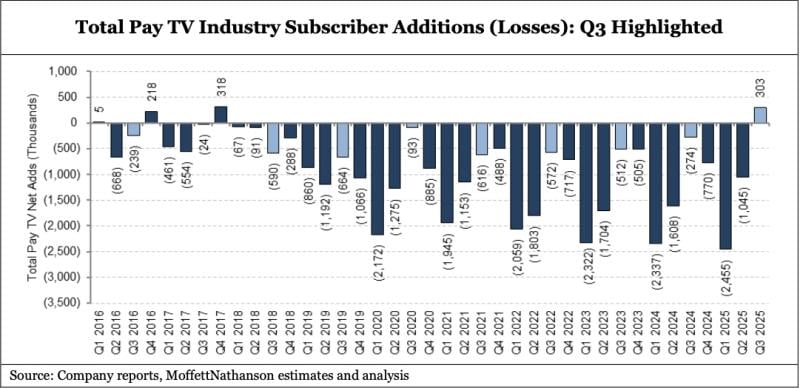
An anonymous reader quotes a report from Ars Technica: On Monday, research analyst MoffettNathanson released its "Cord-Cutting Monitor Q3 2025: Signs of Life?" report. It found that the pay TV operators, including cable companies, satellite companies, and virtual multichannel video programming distributors (vMVPDs) like YouTube TV and Fubo, added 303,000 net subscribers in Q3 2025. According to the report, "There are more linear video subscribers now than there were three months ago. That's the first time we've been able to say that since 2017."

In Q3 2017, MoffettNathanson reported that pay TV gained 318,000 net new subscribers. But since then, the industry's subscriber count has been declining, with 1,045,000 customers in Q2 2025, as depicted in the graph [here]. The world's largest vMVPD by subscriber count, YouTube TV, claimed 8 million subscribers in February 2024; some analysts estimate that number is now at 9.4 million. In its report, MoffettNathanson estimated that YouTube TV added 750,000 subscribers in Q3 2025, compared to 1 million in Q3 2024.

Traditional pay TV companies also contributed to the industry's unexpected growth by bundling its services with streaming subscriptions. Charter Communications offers bundles with nine streaming services, including Disney+, Hulu, and HBO Max. In Q3 2024, it saw net attrition of 294,000 customers, compared to about 70,000 in Q3 2025. Other cable companies have made similar moves. Comcast, for example, launched a streaming bundle with Netflix, Peacock, and Apple TV in May 2024. For Q3 2025, Comcast reported its best pay TV subscriber count in almost five years, which was a net loss of 257,000 customers.
"Traditional pay TV -- i.e. cable and satellite -- still declined quarter over quarter in Q3, but again, by less," noted SteamTV Insider. "The [year-over-year] rate of attrition dropped from -12.4 percent to -10.2 percent over 12 months."

MoffettNathanson added: "Yes, Q3 saw a positive net add number for [pay TV for] the first time in eight years, but that positive result came in the year's seasonally strongest quarter. We're not yet close to seeing the category actually grow again..."
The Courts

Netflix Faces Consumer Class Action Over $72 Billion Warner Bros Deal (reuters.com) 49

Netflix's $72 billion bid to buy Warner Bros Discovery has triggered a consumer class action claiming the merger would crush competition, erase HBO Max as a rival, and hand Netflix control over major franchises. Reuters reports: The proposed class action (PDF) was filed on Monday by a subscriber to Warner Bros-owned HBO Max who said the proposed deal threatened to reduce competition in the U.S. subscription video-on-demand market. "Netflix has demonstrated repeated willingness to raise subscription prices even while facing competition from full-scale rivals such as WBD," the lawsuit said. [...] The lawsuit said the Warner Bros deal would eliminate one of Netflix's closest rivals, HBO Max, and give Netflix control over Warner Bros marquee franchises including Harry Potter, DC Comics and Game of Thrones. On Monday, Paramount Skydance launched a $108 billion hostile bid to buy Warner Bros. Discovery with an all-cash, $30-per-share offer.
Television

Paramount Skydance Launches Hostile Bid For WBD After Netflix Wins Bidding War (cnbc.com) 66

Paramount Skydance is launching a hostile bid to buy Warner Bros. Discovery after it lost out to Netflix in a months-long bidding war for the legacy assets, the company said Monday. CNBC: Paramount will go straight to WBD shareholders with an all-cash, $30-per-share offer. That's the same bid WBD rejected last week, according to people familiar with the bid who asked not to be named because the details were private. The offer is backstopped with equity financing from the Ellison family and the private-equity firm RedBird Capital and $54 billion of debt commitments from Bank of America, Citi and Apollo Global Management.

"We're really here to finish what we started," Ellison told CNBC's "Squawk on the Street" Monday. "We put the company in play." On Friday, Netflix announced a deal to acquire WBD's studio and streaming assets for $72 billion. David Ellison-run Paramount had been bidding for the entirety of Warner Bros. Discovery, including those assets and the company's TV networks like CNN and TNT Sports.

PlayStation (Games)

Why Gen Z is Using Retro Tech (bbc.com) 62

"People in their teens and early 20s are increasingly turning to old school tech," reports the BBC, "in a bid to unplug from the online world." Amazon UK told BBC Scotland News that retro-themed products surged in popularity during its Black Friday event, with portable vinyl turntables, Tamagotchis and disposable cameras among their best sellers. Retailers Currys and John Lewis also said they had seen retro gadgets making a comeback with sales of radios, instant cameras and alarm clocks showing big jumps.

While some people scroll endlessly through Netflix in search of their next watch, 17-year-old Declan prefers the more traditional approach of having a DVD in his hands. He grew up surrounded by his gran's collection and later bought his own after visiting a shop with a friend. "The main selling point for me is the cases," he says. Streaming services like Netflix and Disney+ dominate the market but Declan says he values ownership. "It's nice to have something you own instead of paying for subscriptions all the time," he says. "If I lost access to streaming tomorrow, I'd still have my favourite movies ready to watch."

He admits DVDs are a "dying way of watching movies" but that makes them cheaper. "I think they're just cool, there's something authentic about having DVDs," he says. "These things are generations old, it's nice to have them available."

The BBC also writes that one 21-year-old likes the "deliberate artistry" of traditional-camera photography — and the nostalgic experience of using one. They interview a 20-year-old who says vinyl records have a "more authentic sound" — and he appreciates having the physical disc and jacket art.

And one 21-year-old even tracked down the handheld PlayStation Portable he'd used as a kid...
Movies

Is Netflix Trying to Buy Warner Bros. or Kill It? (variety.com) 58

Why does Netflix want to buy Warner Bros, asks the chief film critic at the long-running motion-picture magazine Variety. "It is hard, at this moment, to resist the suspicion that the ultimate reason... is to eliminate the competition." [Warner Bros. is] one of the only companies that's keeping movies as we've known them alive... Some people think movies are going the way of the horse-and-buggy. A company like Warner Bros. has been the tangible proof that they're not. Ted Sarandos, the co-CEO of Netflix, has a different agenda. He has been unabashed about declaring that the era of movies seen in movie theaters is an antiquated concept. This is what he believes — which is fine. I think a more crucial point is that this is what he wants.

The Netflix business strategy isn't simply about being the most successful streaming company. It's about changing the way people watch movies; it's about replacing what we used to call moviegoing with streaming. (You could still call it moviegoing, only now you're just going into your living room.) It in no way demonizes Sarandos — he'd probably take it as a compliment — to say that there's a world-domination aspect to the Netflix grand strategy. Sarandos's vision is to have the entire planet wired, with everyone watching movies and shows at home. There's a school of thought that sees this an advance, a step forward in civilization. "Remember the days when we used to have to go out to a movie theater? How funny! Now you can just pop up a movie — no trailers! — with the click of a remote...."

Once he owns Warner Bros., will Sarandos keep using the studio to make movies that enjoy powerful runs in theaters the way Sinners and Weapons and One Battle After Another did? In the statement he made to investors and media today, Sarandos said, "I'd say right now, you should count on everything that is planned on going to the theater through Warner Bros. will continue to go to the theaters through Warner Bros." He added, "But our primary goal is to bring first-run movies to our members, because that's what they're looking for." Not exactly a ringing declaration of loyalty to the religion of cinema. And given Sarandos's track record, there is no reason to believe that he will suddenly change his spots.

A letter sent to Congress by a group of anonymous Hollywood producers, who voiced "grave concerns" about Netflix buying Warner Bros., stated, "They have no incentive to support theatrical exhibition, and they have every incentive to kill it." If that happens, though, I have no doubt that Sarandos will be smart enough to do it gradually. Warner Bros. films will probably be released in a "normal" fashion...for a while. Maybe a year or two. But five years from now? There is good reason to believe that by then, a "Warner Bros. movie," even a DC comic-book extravaganza, would be a streaming-only release, or maybe a two-weeks-in-theaters release, all as a more general way of trying to shorten the theatrical window, which could be devastating to the movie business.

Do we know all this to be true? No, but the indicators are somewhat overpowering. (He's been explicit about the windows...)

An anonymous group of "concerned feature film producers" sent an open letter to Congress warning Netflix would "effectively hold a noose around the theatrical marketplace," reports Variety.

And CNN also got this quote from Cinema United, a trade association that represents more than 30,000 movie screens in the United States. "Netflix's stated business model does not support theatrical exhibition," Cinema United President/CEO Michael O'Leary said in a statement. "In fact, it is the opposite."
Television

Could Netflix's Deal for Warner Bros. Fall Apart? (cnbc.com) 54

While Netflix hopes to buy Warner Bros. Discovery for $72 billion, CNBC reports a senior official in America's federal government said the administration was viewing the deal with "heavy skepticism. And that's not the only hurdle: On Thursday, The Wall Street Journal reported that Paramount, in a letter to lawyers for Warner Bros. Discovery [WBD], had warned that a sale to Netflix likely would "never close" because of regulatory challenges in the United States and overseas. "Acquiring Warner's streaming and studio assets 'will entrench and extend Netflix's global dominance in a matter not allowed by domestic or foreign competition laws,' Paramount's lawyers wrote," the Journal reported.
Paramount "is now weighing its options about whether to go straight to shareholders with one more improved bid," CNBC reported Friday, "perhaps even higher than the $30-per-share, all-cash offer it submitted to Warner Bros. Discovery this week."

And CNBC reported Friday that the review by America's Department of Justice "can take anywhere from months to more than a year." Netflix said Friday it expects the transaction to close in 12 to 18 months, after Warner Bros. Discovery spins out its portfolio of cable networks into Discovery Global... As part of the deal, Netflix has agreed to pay a $5.8 billion breakup fee to Warner Bros. Discovery if the deal were to get blocked by the government.
Netflix's planned move is already drawing high-powered criticism, reports CNN:
  • "The world's largest streaming company swallowing one of its biggest competitors is what antitrust laws were designed to prevent. The outcome would eliminate jobs, push down wages, worsen conditions for all entertainment workers, raise prices for consumers, and reduce the volume and diversity of content for all viewers...." the Writers Guild of America union representing Hollywood writers.
  • "Producers are rightfully concerned... Our legacy studios are more than content libraries — within their vaults are the character and culture of our nation." — The Producers Guild of America
  • The deal raises "many serious questions" about the entertainment industry's future, "especially the human creative talent whose livelihoods and careers depend on it." — SAG-AFTRA, Hollywood's biggest actors union
  • "This is not a win for consumers. Netflix has already aggressively raised prices, increased ad load, and stopped people from sharing passwords. Absorbing a competitor with strong content will only lead to its service becoming more expensive and give consumers less choice." — Ross Benes, a senior analyst at eMarketer, told CNN. [Benes also thinks this could mean fewer companies spending heavily on movies and TV shows. "This contracts the industry."

Businesses

Netflix To Buy Warner Bros. In $72 Billion Cash, Stock Deal (bloomberg.com) 73

Netflix is buying Warner Bros. Discovery in an $82.7 billion deal that gives it HBO, iconic franchises, and major studio infrastructure. "Warner Bros. shareholders will receive $27.75 a share in cash and stock in Netflix," notes Bloomberg. "The total equity value of the deal is $72 billion, while the enterprise value of the deal is about $82.7 billion." From the report: Prior to the closing of the sale, Warner Bros. will complete the planned spinoff of its networks division, which includes cable channels such as CNN, TBS and TNT. That transaction is now expected to be completed in the third quarter of 2026, Netflix said in a statement. With the purchase, Netflix becomes owner of the HBO network, along with its library of hit shows like The Sopranos and The White Lotus. Warner Bros. assets also include its sprawling studios in Burbank, California, along with a vast film and TV archive that includes Harry Potter and Friends.

Netflix said it expects to maintain Warner Bros.' current operations and build on its strengths, including theatrical releases for films, a point that had been a cause of concern in Hollywood. Netflix said the deal will allow it to "significantly expand" US production capacity and invest in original content, which will create jobs and strengthen the entertainment industry. Still, the combination is also expected to create "at least $2 billion to $3 billion" in cost savings per year by the third year, according to the statement.
U.S. Senator Mike Lee, a Republican from Utah who leads the Senate antitrust committee, said the acquisition "should send alarm to antitrust enforcers around the world."

"Netflix built a great service, but increasing Netflix's dominance this way would mean the end of the Golden Age of streaming for content creators and consumers," Lee wrote in a post on X.

U.S. Senator Elizabeth Warren called it an antitrust "nightmare" that would harm workers and consumers. "A Netflix-Warner Bros would create one massive media giant with control of close to half of the streaming market -- threatening to force Americans into higher subscription prices and fewer choices over what and how they watch, while putting American workers at risk," Warren said on Friday. "It would mean more price hikes, ads, & cookie cutter content, less creative control for artists, and lower pay for workers," she said in a post on X. "The media industry is already controlled by a few corporations with too much power to censor free speech. The gov't must step in."
Movies

RoboCop Statue Rises In Detroit (theguardian.com) 36

alternative_right quotes a report from the Guardian: The statue looms and glints at more than 11 feet tall and weighing 3,500 pounds, looking out at the city with, how to put it ... a characteristically stern expression? Despite its daunting appearance and history as a crimefighter of last resort, the giant new bronze figure of the movie character RoboCop is being seen as a symbol of hope, drawing fans and eliciting selfie mania since it began standing guard over Detroit on Wednesday afternoon. It has been 15 years in the making. Even in a snowstorm in the dark, people were driving by to see it, said Jim Toscano, co-owner of the Free Age film production company, where the statue now stands firmly bolted down near the sidewalk. RoboCop hit theaters in 1987, portraying a near-future Detroit as crime-ridden and poorly protected by a beleaguered and outgunned police force, until actor Peter Weller appeared as a nearly invincible cyborg, apparently created by a nefarious corporation bent on privatizing policing. A grassroots campaign to build a RoboCop statue in Detroit began in 2010, eventually raising over $67,000 on Kickstarter and resulting in a completed sculpture in 2017. However, hosting setbacks caused it to get stuck, "stored away from public view," reports the Guardian. The project finally found a home after business owner Mike Toscano agreed to display it in their new open-air product market, calling it "too unique and too cool not to do."
Data Storage

The Last Video Rental Store Is Your Public Library 27

404 Media's Claire Woodcock writes: As prices for streaming subscriptions continue to soar and finding movies to watch, new and old, is becoming harder as the number of streaming services continues to grow, people are turning to the unexpected last stronghold of physical media: the public library. Some libraries are now intentionally using iconic Blockbuster branding to recall the hours visitors once spent looking for something to rent on Friday and Saturday nights.

John Scalzo, audiovisual collection librarian with a public library in western New York, says that despite an observed drop-off in DVD, Blu-ray, and 4K Ultra disc circulation in 2019, interest in physical media is coming back around. "People really seem to want physical media," Scalzo told 404 Media. Part of it has to do with consumer awareness: People know they're paying more for monthly subscriptions to streaming services and getting less. The same has been true for gaming.

As the audiovisual selector with the Free Library of Philadelphia since 2024, Kris Langlais has been focused on building the library's video game collections to meet comparable interest in demand. Now that every branch library has a prominent video game collection, Langlais says that patrons who come for the games are reportedly expressing interest in more of what the library has to offer. "Librarians out in our branches are seeing a lot of young people who are really excited by these collections," Langlais told 404 Media. "Folks who are coming in just for the games are picking up program flyers and coming back for something like that."
IP disputes are fueling the shift, too.

The report notes how rights and licensing battles are making some films harder to access -- from titles that quietly slip out of commercial circulation, to streaming-only releases that never make it to disc, to entire shows vanishing during mergers like HBO Max-Discovery+. One prominent example is The People's Joker, which was briefly pulled from the Toronto International Film Festival over a conflict with Batman's rightsholders.

Situations like that are pushing librarians to grab physical copies while they still can, before these works risk disappearing altogether.
Television

HBO Max Botches Mad Men's 4K Debut After Streaming Wrong File Showing Visible Crewmembers (arstechnica.com) 39

HBO Max's 4K debut of Mad Men was botched after Lionsgate reportedly supplied the wrong file, leading to visible crew members where someone is seen pumping a vomit hose. Ars Technica reports: Mad Men ran on the AMC channel for seven seasons from 2007 to 2015. The show had a vintage aesthetic, depicting the 1960s advertising industry in New York City. Last month, HBO Max announced it would modernize the show by debuting a 4K version. The show originally aired in SD and HD resolutions and had not been previously made available in 4K through other means, such as Blu-ray.

However, viewers were quick to spot problems with HBO Max's 4K Mad Men stream, the most egregious being visible crew members in the background of a scene. The episode was "Red in the Face" (Season 1, Episode 7), which was reportedly mislabeled. In it, Roger Sterling (John Slattery) throws up oysters. In the 4K version that was streaming on HBO Max, viewers could see someone pumping a vomit hose to make the fake puke flow.

The Hollywood Reporter, citing an anonymous source, said that the error happened because Mad Men production company Lionsgate gave HBO Max the wrong file. The publication reported that Lionsgate "was working on getting HBO Max the correct file(s)" and was readying to provide them at approximately 10 a.m. PT today. The blunder is likely to be fixed for all viewers soon. There were no problems with the HD versions of HBO Max's Mad Men stream.

The Courts

Supreme Court Hears Copyright Battle Over Online Music Piracy (nytimes.com) 32

The Supreme Court appears inclined to side with Cox Communications in a major copyright case, suggesting that ISPs shouldn't be held liable for users' music piracy based solely on "mere knowledge," given the risk of forcing outages for universities, hospitals, and other large customers. The New York Times reports: Leading music labels and publishers who represent artists ranging from Bob Dylan to Beyonce sued Cox Communications in 2018, saying it had failed to terminate the internet connections of subscribers who had been repeatedly flagged for illegally downloading and distributing copyrighted music. At issue is whether providers like Cox can be held legally responsible and be required to pay steep damages -- a billion dollars or more -- if they know that customers are pirating the music but do not take sufficient steps to terminate their internet access.

Justices from across the ideological spectrum on Monday raised concerns about whether finding for the music industry could result in internet providers being forced to cut off access to large account holders such as hospitals and universities because of the illegal acts of individual users. "What is the university supposed to do in your view?" asked Justice Samuel A. Alito Jr., a conservative, suggesting it would be difficult to track down bad actors without the risk of losing service campuswide. "I just don't see how it's workable at all."

"The internet is so amorphous," added Justice Sonia Sotomayor, a liberal, saying that a single "customer" could represent tens of thousands of users, particularly in rural areas where an entire region might be considered a "customer." After nearly two hours of argument, a majority of justices seemed likely to side with Cox and to send the case back to the U.S. Court of Appeals for the Fourth Circuit for review under a stricter standard. Several justices suggested the company's "mere knowledge" of the illegal downloads was not sufficient to hold Cox liable.

Entertainment

Netflix Kills Casting From Phones (theverge.com) 95

An anonymous reader writes: Netflix has removed the ability to cast shows and movies from phones to TVs, unless subscribers are using older casting devices. An updated help page on Netflix's website, first reported by Android Authority, says that the streaming service "no longer supports casting shows from a mobile device to most TVs and TV-streaming devices," and instead directs users to navigate Netflix using the remote that came with their TV hardware.
Advertising

Benedict Cumberbatch Films Two Bizarre Holiday Ads: for 'World of Tanks' and Amazon (pcgamer.com) 17

"There are times when World of Tanks feels less like a videogame and more like a giant ad budget looking for something to be spent on," writes PC Gamer. This year, all those huge sacks with dollar signs on them have been thrown Benedict Cumberbatch's way, making him the game's newest "Holiday Ambassador" and the star of an absolutely bizarre Christmas advert. The story has very little to do with Christmas and, frankly, not much connection to tanks either, featuring Cumberbatch as a sort of chaotic, supernatural therapist trying to bring a meek nerd out of his shell with the help of a chaotic crowd of his other patients. It's a good watch, shedding the usual hard man action star vibe of past celebrity trailers in favour of something that feels more like a mischievous one act play.
Cumberbatch also portrayed Smaug and Sauron in The Hobbit films (2012-2014), Khan in Star Trek Into Darkness (2013), and Dr. Strange in six Marvel movies. And now Amazon has also hired Cumberbatch for what its calls its "Cannes-winning '5-Star Theater' campaign... performing real Amazon customer reviews as theatrical monologues." Cumberbatch performed over 15 reviews, including popular holiday gifts like the Bissell portable carpet cleaner, Toto bidet, and SharkNinja blender — showing that Amazon truly does have something for everyone on your list.
Last year Amazon produced a similar campaign starring Adam Driver ("Kylo Ren" from the final trilogy of Star Wars sequels). "The humor comes from the juxtaposition between Cumberbatch's gravitas and the text itself," reports Adweek, adding that the reviews were curated "using internal AI tools, to find the most oddly specific reviews on the platform."

Amazon will stream Cumberbatch's bizarre ads on major platforms including TikTok, Snapchat, YouTube, Lyft, Uber, Disney/Hulu, Paramount, and Roku, and on several NFL football games.

I remember when Amazon just chose the best funny fake reviews from customers, and then posted them on the front page of Amazon...
Music

Viral Song Created with Suno's genAI Removed From Streaming Platforms, Re-Released With Human Vocals (yahoo.com) 27

An EDM song by the British group Haven ran into trouble in October after it shared clips of upcoming song "I Run" on TikTok.

The song "was an overnight viral sensation online," writes Digital Music News — racking up millions of plays "even before it hit streaming services." (Although the Washington Post notes that "Record labels and TikTok users began questioning whether 'I Run' used an AI deepfake, modeled off British R&B singer Jorja Smith, for the vocals.")

Digital Music News picks up the story: The artist says he used his own voice to record the vocals, and then ran it through layers of processing and filtering to turn it into the female-sounding voice heard in the track. However, that filtering also included the use of the controversial genAI platform Suno — and that's what complicates things... [The article says later that Suno "is currently in the middle of a blockbuster lawsuit with the Big Three major labels over allegations of widespread copyright infringement of sound recordings used during the AI model training process."]

Meanwhile, the song was rapidly amassing listenership. It soared to #11 on the U.S. Spotify chart and #25 on Spotify globally. Videos using the song continued going viral on TikTok and Instagram, including one in which rapper Offset had apparently played the song during a Boiler Room set, which later turned out to be falsified. And then, as quickly as it appeared, "I Run" was taken down from streaming services, including Spotify and Apple Music. That was due, in part, to numerous takedown notices from The Orchard, the label to which Jorja Smith is signed, as well as the RIAA and IFPI. The takedown notices alleged various issues with the track, including the "misrepresentation" of another artist, as well as copyright infringement.

As a result, the song has also been withheld from the Billboard charts, including the Hot 100, on which it had been predicted to debut this week before the controversy. Billboard points out that it "reserves the right to withhold or remove titles from appearing on the charts that are known to be involved in active legal disputes related to copyright infringement that may extend to the deletion of such content on digital service providers."

The song itself has now been re-released with an all-human vocal track. But going forward will the music industry ever work with AI platforms? The Washington Post reports: "I Run" has taken off as record labels remain unsure of the extent to which they should welcome generative AI programs such as Suno or Udio into the industry. After the two AI music companies began growing in popularity, the three major labels — Sony Music, Warner Music Group and Universal Music Group — filed lawsuits against Suno and Udio, claiming that the AI companies have used the labels' sound recordings to train their model.

Since then, UMG and Warnerhave reached agreementsto work with Udio, ending their litigation... It comes shortly after all three major labels licensed their catalogue to Klay, a music streaming start-up that allows users to adjust songs using artificial intelligence. Major licensing organizations such as ASCAP and BMI shared that they would register songs that were partially AI-generated — but not fully generated ones.

Haven appears to present an uncomfortable edge case. While some AI-generated songs that sound broadly like other artists have been allowed to remain on streaming platforms, the voice in "I Run" appears to have been deemed too duplicative for comfort.

Australia

Australia's Streaming Quotas Become Law (deadline.com) 53

Australia's streaming quotas have become law. Legislation requiring the likes of Netflix, Disney+ and HBO Max to spend a portion of their local earnings on original Australian content has been passed in parliament, and now comes into effect. From a report: The quotas were announced earlier this month. This will see global streamers with more than one million Australian subscribers made to spend 10% of their total Australian expenditure -- or 7.5% of their revenues -- on local originals, whether they are dramas, children's shows, docs, or arts and educational programs.

Failing to comply with the rules will see streamers fined up to ten times their annual revenues in Australia. This is more than what broadcasters are liable for if they breach their quota rules laws. Streamers will be given three years to get their production operations in line.

Streamers have long opposed government-set quotas and content levies, arguing they already meaningfully invest in the production sectors of the countries in which they operate. Producers, in general, have welcomed the systems, but remain wary that they could push streaming services out of their countries.

Television

How 'Stranger Things' Defined the Era of the Algorithm (nytimes.com) 21

As Stranger Things releases the first four episodes of its final season today, nearly a decade after its July 2016 premiere, the Netflix series has come to represent something broader than its own popularity -- the embodiment of streaming television's algorithmic philosophy. When the show first appeared, streaming was still finding its footing. Netflix had been producing original series for only a few years, and services like Disney+, Apple TV and HBO Max did not yet exist.

The question then was what form streaming originals would take: experimental fare like Sense8, nonlinear storytelling like the revived Arrested Development, or prestige dramas like House of Cards. The answer came from a popcorn horror thriller set in 1980s small-town Hawkins, Indiana. Matt and Ross Duffer built Stranger Things from vintage pop-culture parts -- Spielberg's coming-of-age sensibilities from E.T., Stephen King's horror and adolescent bonding, John Hughes' mean jocks and soulful goths, and references ranging from Kate Bush to The NeverEnding Story to casting Winona Ryder of Heathers and Beetlejuice fame.

New York Times critic James Poniewozik calls the series "a human-made equivalent of the algorithm" -- the software engine that drives streaming's "if you liked that, you'll like this" recommendation philosophy. Netflix did not invent the idea of copying television success, but the algorithm automated it and made it part of the creative operating system. The show's structure also fits streaming's mechanics: binge-watching encouragement, irregular release schedules, and episodes that assume audiences have time (the last season finale ran two hours and 22 minutes). The story adds: It's why you see a menu of similar thumbnail recommendations once you finish streaming a favorite series, encouraging you not to discover but to replicate. But the spirit behind it also explains why so much original streaming TV feels like the creative product of an algorithm. Consider the recent Netflix drama "The Beast in Me," which pairs familiar prestige-TV stars (Claire Danes of "Homeland" and Matthew Rhys of "The Americans") in a grim, upscale thriller that vaguely recalls something you might have seen on early 2010s Showtime or FX.

Creating the new by swallowing and regurgitating the old is also the signature move of generative A.I., which may be why that medium is so effective at creating works of burnished nostalgia. On Instagram and TikTok, accounts with names like "Maximal Nostalgia" serve up honeyed, uncanny images and videos that testify to how much better life was in a 1980s and 1990s that never existed.

Television

Plex Is Now Enforcing Remote Play Restrictions On TVs 77

Plex is beginning to enforce new restrictions on remote streaming for its TV apps, requiring either a Plex Pass or the cheaper Remote Watch Pass to watch media from servers outside your home network. How-To Geek reports: Plex is now rolling out the remote watch changes to its Roku TV app. This means that you will need a Plex Pass or Remote Watch Pass for your Plex account if you want to stream media from a server outside your home. If you're only watching media from your own server on the same local network as your Roku device, or the owner of the server you're streaming from has Plex Pass, you don't have to do anything.

Plex says this change will come to the other TV apps in 2026, such as Fire TV, Apple TV, and Android TV. Presumably, that will happen when the redesigned app arrives on those platforms. Roku was just the first TV platform to get the new app, which caused a wave of complaints from users about removed functionality and a more clunky redesign. Plex is addressing some of those complaints with more updates, but adding another limitation at the same time isn't a great look.

The Remote Watch Pass costs $2 per month or $20 per year, but there's no lifetime purchase option. You can also use a Plex Pass, which normally costs $7 per month, $70 per year, or $250 for a lifetime license. However, there's currently a 40% off sale for Plex Pass subscriptions.
AI

Warner Music Group Partners With Suno To Offer AI Likenesses of Its Artists 31

Warner Music Group has reached a licensing deal with Suno that will let users create AI-generated music using the voices and likenesses of artists who opt in. WMG says participating artists will have "full control" over how their likeness and music are used. "These will be new creation experiences from artists who do opt in, which will open up new revenue streams for them and allow you to interact with them in new ways," Suno says, adding that users will be able to "build around" an artist's sounds "and ensure they get compensated." WMG is also dropping its previous lawsuit accusing Suno of scraping copyrighted material.

"Along with the licensing agreement, Suno is planning to use licensed music from WMG to build next-gen music generation models that it claims will surpass its flagship v5 model," adds The Verge. "It will also start requiring users to have a paid account to download songs starting next year, with each tier providing a specific number of downloads each month."

Further reading: First 'AI Music Creator' Signed by Record Label. More Ahead, or Just a Copyright Quandry?
Sci-Fi

Mind-Altering 'Brain Weapons' No Longer Only Science Fiction, Say Researchers (theguardian.com) 35

Researchers warn that rapid advances in neuroscience, pharmacology, and AI are bringing "brain weapons" out of science fiction and into real-world plausibility. They argue current arms treaties don't adequately cover these emerging tools and call for a new, proactive framework to prevent the weaponization of the human mind. The Guardian reports: Michael Crowley and Malcolm Dando, of Bradford University, are about to publish a book that they believe should be a wake-up call to the world. [...] The book, published by the Royal Society of Chemistry, explores how advances in neuroscience, pharmacology and artificial intelligence are coming together to create a new threat. "We are entering an era where the brain itself could become a battlefield," said Crowley. "The tools to manipulate the central nervous system -- to sedate, confuse or even coerce -- are becoming more precise, more accessible and more attractive to states."

The book traces the fascinating, if appalling, history of state-sponsored research into central nervous system (CNS)-acting chemicals. [...] The academics argue that the ability exists to create much more "sophisticated and targeted" weapons that would once have been unimaginable. Dando said: "The same knowledge that helps us treat neurological disorders could be used to disrupt cognition, induce compliance, or even in the future turn people into unwitting agents." The threat is "real and growing" but there are gaps in international arms control treaties preventing it from being tackled effectively, they say. [...]

The book makes the case for a new "holistic arms control" framework, rather than relying on existing arms control treaties. It sets out a number of practical steps that could be taken, including establishing a working group on CNS-acting and broader incapacitating agents. Other proposals concern training, monitoring and definitions. "We need to move from reactive to proactive governance," said Dando. Both men acknowledge that we are learning more about the brain and the central nervous system, which is good for humanity. They said they were not trying to stifle scientific progress and it was about preventing malign intent. Crowley said: "This is a wake-up call. We must act now to protect the integrity of science and the sanctity of the human mind."

Music

Udio Users Can't Download Their AI Music Creations Anymore (theverge.com) 23

An anonymous reader shares a report: As part of the settlement with Universal, Udio has amended its terms of service, and users can no longer download their outputs. This has AI music makers furious, and with good reason. Unfortunately, they have little recourse, as the contract they sign when creating a Udio account includes a waiver of the right to bring a class action.
Music

Napster Said It Raised $3 Billion From a Mystery Investor. But Now the 'Investor' and 'Money' Are Gone (forbes.com) 41

An anonymous reader shared this report from Forbes: On November 20, at approximately 4 p.m. Eastern time, Napster held an online meeting for its shareholders; an estimated 700 of roughly 1,500 including employees, former employees and individual investors tuned in. That's when its CEO John Acunto told everyone he believed that the never-identified big investor — who the company had insisted put in $3.36 billion at a $12 billion valuation in January, which would have made it one of the year's biggest fundraises — was not going to come through.

In an email sent out shortly after, it told existing investors that some would get a bigger percentage of the company, due to the canceled shares, and went on to describe itself as a "victim of misconduct," adding that it was "assisting law enforcement with their ongoing investigations." As for the promised tender offer, which would have allowed shareholders to cash out, that too was called off. "Since that investor was also behind the potential tender, we also no longer believe that will occur," the company wrote in the email.

At this point it seems unlikely that getting bigger stakes in the business will make any of the investors too happy. The company had been stringing its employees and investors along for nearly a year with ever-changing promises of an impending cash infusion and chances to sell their shares in a tender offer that would change everything. In fact, it was the fourth time since 2022 they've been told they could soon cash out via a tender offer, and the fourth time the potential deal fell through. Napster spokesperson Gillian Sheldon said certain statements about the fundraise "were made in good faith based on what we understood at the time. We have since uncovered indications of misconduct that suggest the information provided to us then was not accurate."

The article notes America's Department of Justice has launched an investigation (in which Napster is not a target), while the Securities and Exchange Commission has a separate ongoing investigation from 2022 into Napster's scrapped reverse merger.

While Napster announced they'd been acquired for $207 million by a tech company named Infinite Reality, Forbes says that company faced "a string of lawsuits from creditors alleging unpaid bills, a federal lawsuit to enforce compliance with an SEC subpoena (now dismissed) and exaggerated claims about the extent of their partnerships with Manchester City Football Club and Google. The company also touted 'top-tier' investors who never directly invested in the firm, and its anonymous $3 billion investment that its spokesperson told Forbes in March was in "an Infinite Reality account and is available to us" and that they were 'actively leveraging' it..."

And by the end, "Napster appears to have been scrambling to raise cash to keep the lights on, working with brokers and investment advisors including a few who had previously gotten into trouble with regulators.... If it turns out that Napster knew the fundraise wasn't happening and it benefited from misrepresenting itself to investors or acquirees, it could face much bigger problems. That's because doing so could be considered securities fraud."
The Military

Ukraine Is Jamming Russia's 'Superweapon' With a Song (404media.co) 139

Longtime Slashdot reader fahrbot-bot shares a report from 404 Media: The Ukrainian Army is knocking a once-hyped Russian superweapon out of the sky by jamming it with a song and tricking it into thinking it's in Lima, Peru. The Kremlin once called its Kh-47M2 Kinzhal ballistic missiles "invincible." Joe Biden said the missile was "almost impossible to stop." Now Ukrainian electronic warfare experts say they can counter the Kinzhal with some music and a re-direction order. [...] Kinzhals and other guided munitions navigate by communicating with Russian satellites that are part of the GLONASS system, a GPS-style navigation network. Night Watch uses a jamming system called Lima EW to generate a disruption field that prevents anything in the area from communicating with a satellite. Many traditional jamming systems work by blasting receivers on munitions and aircraft with radio noise. Lima does that, but also sends along a digital signal and spoofs navigation signals. It "hacks" the receiver it's communicating with to throw it off course.

Night Watch shared pictures of the downed Kinzhals with 404 Media that showed a missile with a controlled reception pattern antenna (CRPA), an active antenna that's meant to resist jamming and spoofing. "We discovered that this missile had pretty old type of technology," Night Watch said. "They had the same type of receivers as old Soviet missiles used to have. So there is nothing special, there is nothing new in those types of missiles." Night Watch told 404 Media that it used this Lima to take down 19 Kinzhals in the past two weeks. First, it replaces the missile's satellite navigation signals with the Ukrainian song "Our Father Is Bandera."

Any digital noise or random signal would work to jam the navigation system, but Night Watch wanted to use the song because they think it's funny. "We just send a song... we just make it into binary code, you know, like 010101, and just send it to the Russian navigation system," Night Watch said. "It's just kind of a joke. [Bandera] is a Ukrainian nationalist and Russia tries to use this person in their propaganda to say all Ukrainians are Nazis. They always try to scare the Russian people that Ukrainians are, culturally, all the same as Bandera." Once the song hits, Night Watch uses Lima to spoof a navigation signal to the missiles and make them think they're in Lima, Peru. Once the missile's confused about its location, it attempts to change direction. These missiles are fast -- launched from a MiG-31 they can hit speeds of up to Mach 5.7 or more than 4,000 miles per hour -- and an object moving that fast doesn't fare well with sudden changes of direction.

AI

Major Music Labels Strike Deals With New AI Streaming Service (bloomberg.com) 46

An anonymous reader quotes a report from Bloomberg: The world's largest music companies have licensed their works to a music startup called Klay, which is building a streaming service that will allow users to remake songs using artificial intelligence tools. Klay is the first music AI service to reach a deal with all three major record labels, Universal Music Group NV, Sony Music and Warner Music Group Corp., according to people familiar with the deals. Klay plans to announce its agreements in the coming days, said the people, who asked not to be identified discussing confidential plans.

Klay is building a product that will offer the features of a streaming service like Spotify, amplified by AI technology that will let users remake songs in different styles. Klay has licensed the rights to thousands of hit songs so that it can train its large language model. The company has positioned itself as a friend of the industry, offering assurances that the artists and labels will have some control over how their work is used. Klay is led by music producer Ary Attie and also employs former executives from Sony Music and Google's DeepMind, an AI laboratory.

Google

Future Google TV Devices Might Come With a Solar-powered Remote (theverge.com) 31

An anonymous reader shares a report: Epishine, a company that makes solar cells optimized for indoor lighting, has announced its technology is being used in a new remote control for Google TV devices, as spotted by 9to5Google. The remote will rely on rechargeable batteries instead of disposable ones, and thanks to the use of solar cells on both sides it may only run out of power when it gets buried and forgotten in the dark abyss of your couch cushions.
Television

Disney Loses Bid To Block Sling TV's One-Day Cable Passes (theverge.com) 19

A federal judge in New York denied Disney's request to block Sling TV's short-term passes, which give viewers the ability to stream live content for as little as one day. From a report: In a ruling on Tuesday, US District Judge Arun Subramanian ruled that Disney didn't prove that Sling TV's passes caused "irreparable harm" to the entertainment giant, as reported earlier by Cord Cutters.

Disney sued Sling shortly after the live TV streaming service started allowing viewers to purchase temporary access to its library of channels, starting at a single payment of $4.99 for a one-day pass. Several channels included in the package are owned by Disney, including ESPN, ESPN2, ESPN3, and Disney Channel. In its lawsuit, Disney argued that the passes violate an agreement with Sling TV that says the service must give subscribers access to its content through monthly subscriptions.

However, Judge Subramanian argues that this claim isn't likely to succeed, as the contract doesn't stipulate a "minimum subscription length," adding that the agreement's "broad definition" of a subscriber "clearly covers users of the Passes."

Piracy

Tokyo Court Finds Cloudflare Liable For Manga Piracy in Long-Running Lawsuit (torrentfreak.com) 23

A Tokyo court ruled that Cloudflare is liable for aiding manga piracy after failing to act on infringement notices and continuing to cache and serve content for major piracy sites, awarding about $3.2 million in damages. TorrentFreak says the decision sets a significant precedent in Japan, suggesting CDN providers can face direct liability when they don't verify customers or respond adequately to large-scale copyright abuse. From the report: After a wait of more than three and a half years, the Tokyo District Court rendered its decision this morning. In a statement provided to TorrentFreak by the publishers, they declare "Victory Against Cloudflare" after the Court determined that Cloudflare is indeed liable for the pirate sites' activities. In a statement provided to TorrentFreak, the publishers explain that they alerted Cloudflare to the massive scale of the infringement, involving over 4,000 works and 300 million monthly visits, but their requests to stop distribution were ignored.

"We requested that the company take measures such as stopping the distribution of pirated content from servers under its management. However, Cloudflare continued to provide services to the manga piracy sites even after receiving notices from the plaintiffs," the group says. The publishers add that Cloudflare continued to provide services even after receiving information disclosure orders from U.S. courts, leaving them with "no choice but to file this lawsuit."

"The judgment recognized that Cloudflare's failure to take timely and appropriate action despite receiving infringement notices from the plaintiffs, and its negligent continuation of pirated content distribution, constituted aiding and abetting copyright infringement, and that Cloudflare bears liability for damages to the plaintiffs," they write. "The judgment, in that regard, attached importance to the fact that Cloudflare, without conducting any identity verification procedures, had enabled a massive manga piracy site to operate "under circumstances where strong anonymity was secured,' as a basis for recognizing the company's liability."

The publishers believe that the judgment clarifies the conditions under which a company such as Cloudflare incurs liability for copyright infringement. Failure to carry out identity verification appears at the top of the publishers' list, followed by a lack of timely and appropriate action in response to infringement notices sent by rightsholders. "We believe this is an important decision given the current situation where piracy site operators often hide their identities and repeatedly conduct large-scale distribution using CDN services from overseas. We hope that this judgment will be a step toward ensuring proper use of CDN services. We will continue our efforts to protect the rights of works, creators, and related parties, while aiming for further expansion of legitimate content," the publishers conclude.
Cloudflare plans to appeal the verdict.
Movies

Saudi Makes Big Bet On AI Films As Hollywood Moves From Studios To Datacenters (reuters.com) 38

pbahra writes: Saudi Arabia is betting that the future of Hollywood won't be built in physical stages but in datacenters. In a push to anchor itself in next-generation film production, Riyadh-based Humain has led Luma AI's latest Series C round, backing the shift towards cloud-based, AI-generated video rather than traditional studio infrastructure.. Humain's announcement says the new investment will accelerate Luma's development of world models capable of learning from video, audio and language to generate photorealistic scenes, environments and characters on demand. Supporters argue this could upend film-making by pushing much of Hollywood's production pipeline into high-performance datacenters rather than physical sets.

Slashdot Top Deals