Television

Is the TV Industry Finally Conceding That the Future May Not Be 8K? (arstechnica.com) 138

"Technology companies spent part of the 2010s trying to convince us that we would want an 8K display one day..." writes Ars Technica.

"However, 8K never proved its necessity or practicality." LG Display is no longer making 8K LCD or OLED panels, FlatpanelsHD reported today... LG Electronics was the first and only company to sell 8K OLED TVs, starting with the 88-inch Z9 in 2019. In 2022, it lowered the price-of-entry for an 8K OLED TV by $7,000 by charging $13,000 for a 76.7-inch TV. FlatpanelsHD cited anonymous sources who said that LG Electronics would no longer restock the 2024 QNED99T, which is the last LCD 8K TV that it released.

LG's 8K abandonment follows other brands distancing themselves from 8K. TCL, which released its last 8K TV in 2021, said in 2023 that it wasn't making more 8K TVs due to low demand. Sony discontinued its last 8K TVs in April and is unlikely to return to the market, as it plans to sell the majority ownership of its Bravia TVs to TCL.

The tech industry tried to convince people that the 8K living room was coming soon. But since the 2010s, people have mostly adopted 4K. In September 2024, research firm Omdia reported that there were "nearly 1 billion 4K TVs currently in use." In comparison, 1.6 million 8K TVs had been sold since 2015, Paul Gray, Omdia's TV and video technology analyst, said, noting that 8K TV sales peaked in 2022. That helps explain why membership at the 8K Association, launched by stakeholders Samsung, TCL, Hisense, and panel maker AU Optronics in 2019, is dwindling. As of this writing, the group's membership page lists 16 companies, including just two TV manufacturers (Samsung and Panasonic). Membership no longer includes any major TV panel suppliers. At the end of 2022, the 8K Association had 33 members, per an archived version of the nonprofit's online membership page via the Internet Archive's Wayback Machine.

"It wasn't hard to predict that 8K TVs wouldn't take off," the article concludes. "In addition to being too expensive for many households, there's been virtually zero native 8K content available to make investing in an 8K display worthwhile..."
Movies

Brandon Sanderson's Literary Fantasy Universe 'Cosmere' Picked Up by Apple TV (hollywoodreporter.com) 49

Apple TV+ has landed the screen rights to Cosmere, the sprawling literary universe created by Brandon Sanderson. "The first titles being eyed for adaptation are the Mistborn series, for features, and The Stormlight Archive series, for television," reports the Hollywood Reporter. From the report: The deal is rare one, coming after a competitive situation which saw Sanderson meet with most of the studio heads in town. It gives the author rarefied control over the screen translations, according to sources. Sanderson will be the architect of the universe; will write, produce and consult; and will have approvals. That's a level of involvement that not even J.K. Rowling or George R.R. Martin enjoys.

Sanderson's literary success and fan following helped pave the way for such a deal. One of the most prolific and beloved fantasy authors working today, he has sold over 50 million copies of his books worldwide, collectively across his series. [...] While the Cosmere books are set in various worlds and eras, the underlying premise concerns a being named Adolnasium who is killed by a group of conspirators. The being's power is broken into 16 shards, which are then spread out throughout many worlds by the conspirators, spreading many kinds of magic across the universe.

Music

What's the 'Best' Month for New Movies and Music? A Statistical Analysis (statsignificant.com) 7

An analysis of film and music release patterns has found that summer and late fall are the optimal windows for movie premieres, while the music industry has no clear "best" month -- only a worst one, December, which the report's author dubbed "Dump-cember."

For films, the calendar splits into distinct strategic zones. Summer months and holidays see elevated box office because audiences have more free time, and studios chase mega-billion-dollar hits during these windows. October and November see a surge of prestige releases as studios cluster their Oscar hopefuls to keep them fresh in voters' minds when awards season begins in January.

The Silence of the Lambs, which swept the Academy Awards' Big Four categories in 1992, remains the only Best Picture winner in seven decades to have been released in January -- the industry's infamous "Dump-uary." The music industry operates differently. Most months are interchangeable for album releases, but December is uniquely bad. Artists avoid it because they would compete against Christmas classics from Bing Crosby and Andy Williams, both dead for decades. Albums released in December also receive weaker critical reception as measured by Pitchfork scores, and labels quietly slot their least promising projects into this low-attention window.
Television

Television Turns 100 (blogspot.com) 29

Television marks its centenary today, exactly 100 years after Scottish inventor John Logie Baird first demonstrated his electro-mechanical system to journalists and members of the Royal Institution in a cramped attic workshop above what is now Bar Italia in London's Soho.

On January 26, 1926, small groups of visitors climbed to 22 Frith Street and watched fuzzy images of a ventriloquist's dummy called Stooky Bill appear on screen, followed by each other's faces transmitted from a separate room. One visitor got too close to the spinning discs and ended up with a sliced beard. The Times published a short account two days later.

Baird had built his first transmitting equipment in Hastings in 1923 using a hatbox, tea chest, darning needles and bicycle light lenses. A 1000-volt electric shock and a displeased landlord pushed him to London, where Gordon Selfridge soon invited him to demonstrate the device during the store's Birthday Week celebrations. The building at 22 Frith Street now carries three plaques commemorating the invention.
Television

What a Sony and TCL Partnership Means For the Future of TVs (theverge.com) 26

How would Sony ceding control of its TV hardware business change the industry? The Verge has an optimistic take: [...] As of today, Sony already relies on different manufacturing partners to create its TV lineup. While display panel manufacturers never reveal who they sell panels to, Sony is likely already using panels for its LCD TVs from TCL China Star Optoelectronics Technology (CSOT), in addition to OLED panels from LG Display and Samsung Display. With this deal, a relationship between Sony and TCL CSOT LCD panels is guaranteed (although I doubt this would affect CSOT selling panels to other manufacturers). And with TCL CSOT building a new OLED facility, there's a potential future in which Sony OLEDs will also get panels from TCL. Although I should point out that we're not sure yet if the new facility will have the ability to make TV-sized OLED panels, at least to start.

[...] There's some concern from fans that this could lead to a Sharp, Toshiba, or Pioneer situation where the names are licensed and the TVs produced are a shell of what the brands used to represent. I don't see this happening with Sony. While the electronics side of the business hasn't been as strong as in the past, Sony -- and Bravia -- is still a storied brand. It would take a lot for Sony to completely step aside and allow another company to slap its name on an inferior product. And based on TCL's growth and technological improvements over the past few years, and the shrinking gap between premium and midrange TVs, I don't expect Sony TVs will suffer from a partnership with TCL.

Sony

Sony Is Ceding Control of TV Hardware Business To China's TCL (sony.co.jp) 51

Sony plans to spin off its TV hardware business to a new joint venture controlled by Chinese electronics giant TCL, the two said Tuesday, a significant retreat for the Japanese giant whose Bravia line has long occupied the premium end of the television market. TCL would hold a 51% stake in the venture and Sony would retain 49% under a nonbinding agreement the two companies signed. They aim to finalize binding terms by the end of March and begin operations in April 2027, pending regulatory approvals.

The new company would retain the Sony and Bravia branding for televisions and home audio equipment but use TCL's display technology. Japanese TV manufacturers have steadily lost ground to Chinese and Korean rivals over the years. Toshiba, Hitachi, Mitsubishi Electric and Pioneer exited the business entirely. Panasonic and Sharp de-emphasized televisions in their growth strategies. Sony's Bravia line survived by positioning itself at the premium tier where consumers pay more for high-end picture and sound quality.
Sci-Fi

Bank of England 'Must Plan For a Financial Crisis Triggered By Aliens' (msn.com) 80

A former Bank of England analyst has urged contingency planning for a potential financial shock if the U.S. government were to confirm the existence of extraterrestrial intelligence. The argument is that "ontological shock" alone could destabilize confidence and trigger crisis dynamics. The Independent reports: [Helen McCaw, who served as a senior analyst in financial security at the UK's central bank and worked for the Bank of England for 10 years until 2012] said politicians and bankers can no longer afford to dismiss talk of alien life, and warned a declaration of this nature could trigger bank collapses. She reportedly said: "The United States government appears to be partway through a multi-year process to declassify and disclose information on the existence of a technologically advanced non-human intelligence responsible for Unidentified Anomalous Phenomena (UAPs)."

"If the UAP proves to be of non-human origin, we may have to acknowledge the existence of a power or intelligence greater than any government and with potentially unknown intentions." Her warning comes as senior American officials have recently indicated their belief in the possibility of alien life. [...] Ms McCaw said: "UAP disclosure is likely to induce ontological shock and provoke psychological responses with material consequences ... There might be extreme price volatility in financial markets due to catastrophising or euphoria, and a collapse in confidence if market participants feel uncertain on how to price assets using any of the familiar methods."

The former Bank of England worker explained there might be a rush towards assets such as gold or other precious metals, and government bonds, which are perceived as "safe." Alternatively, she said precious metals might lose their status as perceived safe assets if people speculate that new space-faring technologies will soon increase the supply of precious metals.
The article cites a recent UFO documentary, The Age of Disclosure, where 34 U.S. government insiders, including those from the military and intelligence community officials, share insights about the governments work with UAP. Per the film's description, the documentary "reveals an 80-year global cover-up of non-human intelligent life and a secret war among major nations to reverse-engineer advanced technology of non-human origin."
United States

The Rise and Fall of the American Monoculture (wsj.com) 66

The American monoculture -- the era when three television networks, seven movie studios, and a handful of record labels determined virtually everything the country watched and heard -- is collapsing under the weight of algorithmic recommendation engines and infinite streaming options. An estimated 200 million tickets were sold for "Gone With the Wind" in 1939 when the U.S. population was 130 million; more than 100 million people watched the MAS*H finale in 1983.

Only three American productions grossed more than $1 billion in 2025, down from nine in 2019. "That broad experience has become a more difficult thing for us studio people to manufacture," said Donna Langley, chairman of NBCUniversal Entertainment. "The audience wants a much better value for their money."

YouTube became the most popular video platform on televisions not by having the hottest shows but by having something for everyone. The internet broke Hollywood's hold on distribution; anyone can now stream to the same devices Disney and Netflix use.
Television

Netflix Wants Plots Explained Multiple Times Because Viewers Are on Their Phones, Matt Damon Says (nme.com) 98

Netflix has begun asking filmmakers to adjust their storytelling approach to account for viewers who are scrolling through their phones while watching, according to Matt Damon. The traditional action movie formula involves three major set pieces distributed across the first, second, and third acts. Netflix now wants a large action sequence in the opening five minutes to hook viewers.

The streamer has also suggested that filmmakers reiterate plot points "three or four times in the dialogue" to accommodate distracted audiences, he said. "It's going to really start to infringe on how we're telling these stories," Damon said.
AI

Partly AI-Generated Folk-Pop Hit Barred From Sweden's Official Charts (theguardian.com) 20

An anonymous reader shares a report: A hit song has been excluded from Sweden's official chart after it emerged the "artist" behind it was an AI creation. I Know, You're Not Mine -- or Jag Vet, Du Ar Inte Min in Swedish -- by a singer called Jacub has been a streaming success in Sweden, topping the Spotify rankings.

However, the Swedish music trade body has excluded the song from the official chart after learning it was AI-generated. "Jacub's track has been excluded from Sweden's official chart, Sverigetopplistan, which is compiled by IFPI Sweden. While the song appears on Spotify's own charts, it does not qualify for inclusion on the official chart under the current rules," said an IFPI Sweden spokesperson. Ludvig Werber, IFPI Sweden's chief executive, said: "Our rule is that if it is a song that is mainly AI-generated, it does not have the right to be on the top list."

Star Wars Prequels

'Star Wars' Boss Kathleen Kennedy Steps Down From Lucasfilm (apnews.com) 109

After more than 13 years leading Lucasfilm, Kathleen Kennedy is stepping down. "When George Lucas asked me to take over Lucasfilm upon his retirement, I couldn't have imagined what lay ahead," said Kennedy. "It has been a true privilege to spend more than a decade working alongside the extraordinary talent at Lucasfilm." The Associated Press reports: The Walt Disney Co. announced Thursday that it will now turn to Dave Filoni to steer "Star Wars," as president and chief creative officer, into its sixth decade and beyond. Filoni, who served as the chief commercial officer of Lucasfilm, will inherit the mantle of one of the movies marquee franchises, alongside Lynwen Brennan, president and general manager of Lucasfilm's businesses, who will serve as co-president.

Kennedy, Lucas' handpicked successor, had presided over the ever-expanding science-fiction world of "Star Wars" since Disney acquired it in 2012. In announcing Thursday's news, Bob Iger, chief executive officer of the Walt Disney Co. called her "a visionary filmmaker." Kennedy oversaw a highly lucrative but often contentious period in "Star Wars" history that yielded a blockbuster trilogy and acclaimed streaming spinoffs such as "The Mandalorian" and "Andor," yet found increasing frustration from longtime fans.

Under Kennedy's stewardship, Lucasfilm amassed more than $5.6 billion in box office and helped establish Disney+ as a streaming destination -- achievements that easily validated the $4.05 billion Disney plunked down for the company. But Kennedy also struggled to deliver the big-screen magic that Lucas captured in the original trilogy from the late 1970s and early 1980s, and her relationship with "Star Wars" loyalists became a saga of its own.

Television

Amazon Is Making a Fallout Shelter Competition Reality TV Show (engadget.com) 25

Amazon is expanding the Fallout universe with Fallout Shelter, a ten-episode reality competition show where contestants face survival-style challenges and moral dilemmas for a cash prize. Engadget reports: Prime Video has greenlit a unscripted reality show titled Fallout Shelter. It will be a ten-episode run with Studio Lambert, the team behind reality projects including Squid Game: The Challenge and The Traitors, as its primary producer. Bethesda Game Studios' head honcho Todd Howard is attached as an executive producer. Amazon's description of Fallout Shelter is: "Across a series of escalating challenges, strategic dilemmas and moral crossroads, contestants must prove their ingenuity, teamwork and resilience as they compete for safety, power and ultimately a huge cash prize."

[...] The name echos the free-to-play mobile game Bethesda released in 2015. Fallout Shelter lets people build and improve their out Vault-Tec residence, managing the resources for a growing cadre of underground survivors. It seems pretty likely that there will be some type of tie-in between the game and the show, but any details about that might pop up closer to when the program is ready to air. It's currently casting, and no release timeline has been shared.

AI

Bandcamp Bans AI Music 39

Bandcamp has announced a ban on music made wholly or substantially by generative AI, aiming to protect human creativity and prohibit AI impersonation of artists. Here's what the music platform had to say: ... Something that always strikes us as we put together a roundup like this is the sheer quantity of human creativity and passion that artists express on Bandcamp every single day. The fact that Bandcamp is home to such a vibrant community of real people making incredible music is something we want to protect and maintain. Today, in line with that goal, we're articulating our policy on generative AI. We want musicians to keep making music, and for fans to have confidence that the music they find on Bandcamp was created by humans.

Our guidelines for generative AI in music and audio are as follows:
- Music and audio that is generated wholly or in substantial part by AI is not permitted on Bandcamp.
- Any use of AI tools to impersonate other artists or styles is strictly prohibited in accordance with our existing policies prohibiting impersonation and intellectual property infringement.

If you encounter music or audio that appears to be made entirely or with heavy reliance on generative AI, please use our reporting tools to flag the content for review by our team. We reserve the right to remove any music on suspicion of being AI generated. We will be sure to communicate any updates to the policy as the rapidly changing generative AI space develops. Given the response around this to our previous posts, we hope this news is welcomed. We wish you all an amazing 2026. [...]
Television

Batman TV Series Premiered 60 Years Ago Today (cordcuttersnews.com) 47

60 years ago today, ABC aired the first episode of its live-action Batman television series, introducing Adam West as the deadpan Caped Crusader in what became a pop culture phenomenon blending high-camp humor and cliffhanger thrills. The mid-season replacement ran for 120 episodes over three seasons before ending in March 1968.
Television

Streamer Spend To Top $100B For First Time In 2026 (deadline.com) 32

Streamer spend on content is set to top the $100 billion mark for the first time this year, according to an Ampere Analysis report. From a report: The landmark figure will be met as global streamers "remain the primary driver of growth in content investment," according to Ampere. Spend by the likes of Netflix, Disney+, Prime Video, HBO Max, Paramount+ and Apple TV will shoot up 6% this year, helping lead to a 2% increase in overall global content spend, Ampere forecast. The $101 billion figure, the first time streamer spend has crossed that major $100 Billion landmark, will represent around two-fifths of the overall figure.
Television

The Gap Between Premium and Budget TV Brands is Quickly Closing (theverge.com) 57

The long-standing hierarchy in the TV market -- Sony, Samsung and LG at the top, TCL and Hisense fighting it out in the midrange -- is eroding as the budget brands close the performance gap and increasingly lead on technology innovation, The Verge writes. Hisense debuted the first RGB LED TV last year, and TCL's X11L announced at CES 2026 is the first TV to use reformulated quantum dots and a new color filter. TCL's QM9K release last year was "a pretty clear statement that they're ready to fight with the big boys."

The premium brands retain certain advantages: Sony's processing remains unmatched and LG's OLEDs deliver contrast that mini LED cannot match. "Even as the gap in performance across technologies continues to shrink, and TVs from all the manufacturers get closer to parity, the challenge for TCL and Hisense shifts from creating incredible, competitive products to altering perception," The Verge notes.

Samsung once owned the art TV segment entirely; CES 2026 saw announcements from Amazon's Ember Artline and LG's Gallery TV, all using similar edge-lit technology and magnetic frames. The experience across brands is "remarkably similar." If the pricing gap persists and performance remains comparable, "the big three will have to respond by bringing their pricing down or risk losing sales," the publication concluded.
Television

TV Makers Are Taking AI Too Far (theverge.com) 53

TV manufacturers at CES 2026 in Las Vegas this week unveiled a wave of AI features that frequently consume significant screen space and take considerable time to deliver results -- all while global TV shipments declined 0.6% year over year in Q3, according to Omdia. Google demonstrated Veo generating video from a photo on a television, a process that took about two minutes to produce eight seconds of footage, The Verge writes in a column. Samsung presented a future where viewers ask their sets for sports predictions and recipes to share with kitchen displays. Hisense showed an AI agent that displays real-time stats for every soccer player on screen, a feature requiring so much space the company built a prototype 21:9 aspect ratio display to accommodate it.

Demos repeatedly showed video shrinking to make room for sports scores and information when viewers asked questions -- noticeable on 70-inch displays and likely worse on anything 50 inches or smaller. Amazon's Alexa Plus can jump to Prime Video scenes based on verbal descriptions. LG's sets switch homescreen recommendations based on voice recognition of individual family members.
Privacy

Samsung Hit with Restraining Order Over Smart TV Surveillance Tech in Texas (texasattorneygeneral.gov) 59

Texas Attorney General Ken Paxton has secured a temporary restraining order against Samsung, blocking the company from continuing to collect data through its smart TVs' Automated Content Recognition technology.

The ACR system captured screenshots of what users were watching every 500 milliseconds, according to the state's lawsuit, and did so without consumer knowledge or consent. The District Court found good cause to believe Samsung's actions violated the Texas Deceptive Trade Practices Act. The TRO prohibits Samsung and any parties working in concert with the company from using, selling, transferring, collecting, or sharing ACR data tied to Texas consumers.

Samsung is one of five major TV manufacturers the Texas Attorney General's office has sued over ACR deployment. Paxton previously secured a similar order against Hisense.
Television

How Did TVs Get So Cheap? (construction-physics.com) 109

A 50-inch TV that would have set you back $1,100 at Best Buy during Black Friday 2001 now costs less than $200, and the price per area-pixel -- a metric accounting for both screen size and resolution -- has dropped by more than 90% over the past 25 years. The story behind this decline is largely one of liquid crystal display technology maturing from a niche product to a mass-manufactured commodity.

LCDs represented just 5% of the TV market in 2004; by 2018, they commanded more than 95%. The largest driver of cost reduction has been the scaling up of "mother glass" sheets -- the large panels of extremely clear glass onto which semiconductor materials are deposited before being cut into individual displays. The first generation sheets measured roughly 12 by 16 inches. Today's Generation 10.5 sheets span 116 by 133 inches, nearly 100 times the original area. This scaling delivers substantial savings because equipment costs rise more slowly than glass area increases.

Moving from Gen 4 to Gen 5 mother glass cut the cost per diagonal inch by 50%. Equipment costs per unit of panel area fell 80% between Gen 4 and Gen 8. Process improvements have compounded these gains: masking steps required for thin-film transistors dropped from eight to four, yields climbed from 50% to above 90%, and a "one drop fill" technique reduced liquid crystal filling time from days to minutes.
Television

Disney+ To Add Vertical Videos In Push To Boost Daily Engagement (deadline.com) 49

Disney+, which is looking to catch up with some streaming and digital rivals in terms of daily engagement, is adding vertical videos to the service. From a report: The arrival of the new format later this year was one of several advertising-oriented announcements the company made Wednesday at its Tech + Data Showcase at CES in Las Vegas. Other new offerings include a new "brand impact" metric and a new video generation tool that helps advertisers create high-quality connected-TV-ready commercials using existing assets and guidelines.

[...] In an interview prior to the Wednesday showcase, Erin Teague, EVP of Product Management for Disney Entertainment and ESPN, said "everything's on the table" in terms of how vertical video is delivered on Disney+. It could be original short-form programming, repurposed social clips, refashioned scenes from longer-form episodic or feature titles or a combination. "We're obviously thinking about integrating vertical video in ways that are native to core user behaviors," Teague said. "So, it won't be a kind of a disjointed, random experience."

Television

The Inevitable Rise of the Art TV (wired.com) 53

Several years after Samsung introduced the Frame TV in 2017 -- a television designed to display fine art and resemble a framed painting when switched off -- competitors are finally catching up in meaningful numbers. Amazon announced the Ember Artline TV at CES 2026 this week, a $899 model that can display one of 2,000 works of art for free and includes an Alexa AI tool to recommend pieces suited to your room. Hisense unveiled its CanvasTV late last year, TCL has the NXTvision model, and LG has announced the Gallery TV for later this year.

The surge in art-focused televisions comes down to two factors: smaller living spaces in cities where younger buyers lack dedicated rooms for large screens, and advances in matte screen technology that enable displays to absorb light like a canvas rather than reflect it like a window. Local dimming and improved backlighting processing allow these newer models to maintain their slim profiles for flush wall-mounting while delivering more realistic art reproduction than earlier edge-lit designs.
It's funny.  Laugh.

South Korea's President Identifies a New Enemy: Baldness (msn.com) 32

South Korea's President Lee Jae Myung asked at a televised policy meeting last month whether the country's state-run healthcare plan could cover hair-loss treatment, framing it as a question about whether hair loss qualifies as a disease. The health minister told Lee that baldness is generally considered an aesthetic problem and therefore covered out-of-pocket, but the 61-year-old president -- who himself has a full head of hair -- pushed back, arguing that young people experiencing thinning hair view their situation as a "matter of survival."

The proposal has divided the country. South Korea is known for a cultural phenomenon called "lookism," where physical appearance carries significant weight in professional and social settings. The expression "your appearance is also a credential" is common, and nearly all job applications require a photograph, including those for part-time barista positions.

Lee first made the pledge to cover hair-loss treatment during his unsuccessful 2022 presidential campaign but dropped it when he ran again. He won a snap election in June and has now resurrected the idea as a way to appeal to younger voters who have grown more dissatisfied with him. The Korean Medical Association has called the proposal "questionable" given the health system's stretched finances. The health ministry is currently reviewing whether the treatments are appropriate for coverage. More than three in four South Koreans believe everyone has concerns about hair loss, according to a recent Embrain Trend Monitor poll.
Television

Corporation for Public Broadcasting To Shut Down After 58 Years (variety.com) 171

After Congress approved President Donald Trump's rescission package eliminating federal funding, the Corporation for Public Broadcasting voted to dissolve after 58 years, rather than continue to exist and potentially be "vulnerable to future political manipulation or misuse." The shutdown leaves hundreds of local public TV and radio stations facing an uncertain future. Variety reports: The CPB was created by Congress by the Public Broadcasting Act of 1967 to support the federal government's investment in public broadcasting. The org noted that the rescission of all of CPB's federal funding came after years of political attacks. "For more than half a century, CPB existed to ensure that all Americans -- regardless of geography, income, or background -- had access to trusted news, educational programming, and local storytelling," said CPB president/CEO Patricia Harrison. "When the Administration and Congress rescinded federal funding, our Board faced a profound responsibility: CPB's final act would be to protect the integrity of the public media system and the democratic values by dissolving, rather than allowing the organization to remain defunded and vulnerable to additional attacks.

[...] "CPB's support extends to every corner of the country -- urban, rural, tribal, and everywhere in between," the org noted. "In many communities, public media stations are the only free source of trusted news, educational children's programming, and local and national cultural content." The CPB said that without funding, its board determined that "maintaining the corporation as a nonfunctional entity would not serve the public interest or advance the goals of public media. A dormant and defunded CPB could have become vulnerable to future political manipulation or misuse, threatening the independence of public media and the trust audiences place in it, and potentially subjecting staff and board members to legal exposure from bad-faith actors."

As it closes, CPB is distributing its remaining funds, and also supporting the American Archive of Public Broadcasting in digitizing and preserving historic content. The CPB's own archives will be preserved at the University of Maryland, which will make it accessible to the public. "Public media remains essential to a healthy democracy," Harrison added. "Our hope is that future leaders and generations will recognize its value, defend its independence, and continue the work of ensuring that trustworthy, educational, and community-centered media remains accessible to all Americans."

Music

Samsung's CES Concepts Disguise AI Speakers as Turntables and Cassette Players (samsungdisplay.com) 13

Samsung is bringing a pair of retro-styled speaker concepts to CES 2026 that combine old-school aesthetics with OLED screens and AI-powered music recommendations, and the company is positioning them as alternatives to conventional Bluetooth speakers that typically depend on a paired smartphone or tablet for content selection. The "AI OLED Cassette" features a 1.5-inch round OLED display, while the larger "AI OLED Turntable" uses a 13.4-inch round panel, and both allow users to receive music suggestions, browse and select content directly on the device, and set ambient moods using images and video playback.
Lord of the Rings

2025 Ends With Release of J. R. R. Tolkein's Unpublished Story (lareviewofbooks.org) 16

2025'S final months finally saw the publication of J.R.R. Tolkein's The Bovadium Fragments, writes the Los Angeles Review of Books: Anyone who has read Tolkien's letters will know that he is at his funniest when filled with rage, and The Bovadium Fragments is a work brimming with Tolkien's fury — specifically, ire over mankind's obsession with motor vehicles. Tolkien's anger is expressed through a playful satire told from the perspective of a group of future archaeologists who are studying the titular fragments, which tell of a civilization that asphyxiated itself on its own exhaust fumes. Tolkien's fictional fragments use the language of ancient myth, reframing modern issues like traffic congestion and parking with a grandeur that highlights their total absurdity. It is Tolkien at his angriest and funniest, making The Bovadium Fragments a minor treasure in his ever-growing catalog...

As Tolkien put it in one of his private letters, "the spirit of 'Isengard,' if not of Mordor, is of course always cropping up. The present design of destroying Oxford in order to accommodate motor-cars is a case." Readers of The Lord of the Rings (1954-55) will recognize the allusion. In the author's magnum opus, Isengard is a kind of industrial hell, endlessly feeding its furnaces with felled trees... The Bovadium Fragments brings Tolkien's visceral hatred of such machines to the fore for the first time — on the same level as Isengard or the scoured Shire. In Tolkien's story, the words "Motores" and "monsters" are interchangeable. And with his grand, mythic register, Tolkien defamiliarizes the car enough for modern readers to see it as he does — as truly monstrous. "[T]he Motores continued to bring forth an ever larger progeny," Tolkien writes. "[M]any of the citizens harboured the monsters, feeding them with the costly oils and essences which they required, and building houses for them in their gardens...."

One suspects that Tolkien would have preferred to see Oxford return to the era of the donkey cart. That kind of nostalgia is familiar in Tolkien's work — the idea that we developed just a little too far, skipping past an Eden we failed to recognize a generation or two ago. (For Tolkien, the paragon of paradise seems to have been a rural village around the time of Queen Victoria's Diamond Jubilee.) But he also knows that mankind's impulse to develop is something we cannot help. And the inevitable blowback we get from our hubris is something we cannot avoid. That defeatist attitude is suggested in the frame narrative to The Bovadium Fragments, in which the archaeologists smugly declare their superiority to the extinct citizens of old Oxford. "We at any rate are not likely to fall into such folly," one of them says.

In their more enlightened future, we are told, they only pursue the more benign science of longevity. Their wish is that one day they shall "at last conquer mortality, and not 'die like animals.'" But humans are animals, Tolkien argues. And in stretching beyond that, we may find progress and modern conveniences like motorcars. But perhaps we also pave a road to Isengard. And we may not recognize that destination until it is too late — until we are trapped within its walls, suffocating on our own exhaust fumes.

Television

MTV's Music-Only Channels Go Off the Air (rollingstone.com) 51

An anonymous reader shares a report: MTV shut down many of its last dedicated 24-hour music channels Dec. 31. The move, announced back in October, affected channels around the world, with the U.K. seeing five different MTV stations going dark. These include MTV Music, MTV 80s, MTV 90s, Club MTV, and MTV Live. As Consequence notes, MTV Music -- which launched in 2011 -- notably ended its run by airing the Buggles' "Video Killed the Radio Star," the first visual to air when MTV launched in the United States in 1981.

MTV's parent company, Paramount Skydance, is also expected to shutter music-only channels in Australia, Poland, France, and Brazil. Despite axing much of its dedicated music programming, MTV's flagship channels are still expected to keep broadcasting in the U.K. and elsewhere. Like in the U.S., these channels primarily air massively popular reality programs, as opposed to music videos.

Movies

Slashdot Asks: Your Favorite 2025 Movies, TV Shows and Books? 46

Another year wraps up, and with it comes the annual ritual of taking stock. What were the movies, TV shows and books from this year that stood out to you? Not necessarily the ones that dominated conversation or topped charts, but the ones you found yourself recommending to friends, or returning to for a second watch or read.

Share your picks and, if you're inclined, a line or two on what made them stick.
AI

'2025 Was the Year of Creative Bankruptcy' 23

PC Gamer argues that 2025 was a year full of high-profile AI embarrassments across games and entertainment, with Disney and Lucasfilm serving as the "opening salvo." From the report: At a TED talk back in April, Lucasfilm senior vice president of creative innovation Rob Bredow presented a demonstration of what he called "a new era of technology." Across 50 years of legendary innovation in miniature design, practical effects, and computer animation, Lucasfilm and its miracle workers at Industrial Light & Magic have blazed the trail for visual effects in creative storytelling -- and now Bredow was offering a glimpse at what wonders might come next.

That glimpse, created over two weeks by an ILM artist, was Star Wars: Field Guide: a two-minute fizzle reel of AI-generated blue lions, tentacled walruses, turtles with alligator heads, and zebra-stripe chimpanzees, all lazily spliced together from the shuffled bits of normal-ass animals. These "aliens" were less Star Wars than they were Barnum & Bailey. It felt like a singular embarrassment: Instead of showing its potential, generative AI just demonstrated how out of touch a major media force had become. And then it kept happening.

At the time, I wondered whether evoking the legacy of Lucasfilm just to declare creative bankruptcy had provoked enough disgusted responses to convince Disney to slow its roll on AI ventures. In the months since, however, it's clear that Star Wars: Field Guide wasn't a cautionary tale. It was a mission statement. Disney is boldly, firmly placing its hand on the hot stove.
Other embarrassing AI use cases include Fortnite's AI-powered Darth Vader NPC, Activision's use of AI-generated art in what was widely described as the "weakest" Call of Duty launch in years, McDonald's short-lived AI holiday ad, and Disney's $1 billion licensing deal with OpenAI.
Television

Americans Are Watching Fewer New TV Shows and More Free TV (bloomberg.com) 71

Americans are settling into streaming habits that should worry Hollywood executives, as new Nielsen data analyzed by Bloomberg reveals that not a single new original series cracked the top 10 most-watched streaming shows in 2025 -- the first time this has happened since Nielsen began publishing streaming data in 2020.

The shift extends beyond original programming as free, ad-supported streaming services are growing faster than their paid counterparts. YouTube has become the most-watched streaming service on American televisions, now larger than Netflix and Amazon combined. The Roku Channel and Tubi have nearly doubled in size over the past two years, while Peacock and Warner Bros.' streaming services have stagnated at roughly half their free competitors' viewership share.

Netflix still dominates when it comes to hits, accounting for about two-thirds of original programs appearing in Nielsen's weekly top 10 lists. But that dominance is eroding -- the company's share of streaming viewership has fallen below 20%. Meanwhile, Disney's streaming services haven't increased their share of TV viewing in three years, and Amazon is closing in. The most-watched original series of 2025 was Squid Game's final season, followed by returning shows Wednesday and Love Island.
Movies

'No Happy Ending for Movie Theatres', Argues WSJ - No Matter Who Wins Warner Bros. (msn.com) 74

Regardless of who ends up owning Warners Bros., "the outlook for theatrical movies is dimming," writes a Wall Street Journal tech columnist, noting that this year's U.S. box office of $8.3 billion (as of December 25) "is a bit below last year's and well below prepandemic levels of around $11 billion." Warner has historically been one of Hollywood's largest producers of theatrical films, averaging about 22 releases annually in the pre-Covid years of 2015 to 2019, according to data from Comscore. Its franchises include "Harry Potter," the DC Comics characters and "Lord of the Rings." But the current bidding war between Netflix and Paramount Skydance means Warner's future will ultimately be in the hands of either a streaming giant with a longstanding distaste for movie theaters, or a rival studio that will carry a sky-high debt load and therefore a need to sharply cut costs... [Though later the article cites a Wedbush analyst's observation that the current theatrical slate has already been negotiated through 2029, "so any buyer would have to honor those contracts" with theatrical releases for Warner films "for at least the next four years."]

Investors seem deeply skeptical. Cinemark shares have shed about 18% of their value over the past month, while rival exhibitor AMC Entertainment is down more than 30%. Morgan Stanley recently downgraded Cinemark to a neutral rating, with analyst Ben Swinburne noting that concern over Netflix's commitment to theatrical distribution and release windows "is likely to cap the multiple" on Cinemark's stock.... [T]ime hasn't been on the side of movie theaters for a while now, and a takeover of Warner Bros. won't turn back that clock.

AI

Did Tim Cook Post AI Slop in His Christmas Message Promoting 'Pluribus'? (daringfireball.net) 23

Artist Keith Thomson is a modern (and whimsical) Edward Hopper. And Apple TV says he created the "festive artwork" shared on X by Apple CEO Tim Cook on Christmas Eve, "made on MacBook Pro."

Its intentionally-off picture of milk and cookies was meant to tease the season finale of Pluribus. ("Merry Christmas Eve, Carol..." Cook had posted.)

But others were convinced that the weird image was AI-generated.

Tech blogger John Gruber was blunt. "Tim Cook posts AI Slop in Christmas message on Twitter/X, ostensibly to promote 'Pluribus'." As for sloppy details, the carton is labeled both "Whole Milk" and "Lowfat Milk", and the "Cow Fun Puzzle" maze is just goofily wrong. (I can't recall ever seeing a puzzle of any kind on a milk carton, because they're waxy and hard to write on. It's like a conflation of milk cartons and cereal boxes.)
Tech author Ben Kamens — who just days earlier had blogged about generating mazes with AI — said the image showed the "specific quirks" of generative AI mazes (including the way the maze couldn't be solved, expect by going around the maze altogether). Former Google Ventures partner M.G. Siegler even wondered if AI use intentionally echoed the themes of Pluribus — e.g., the creepiness of a collective intelligence — since otherwise "this seems far too obvious to be a mistake/blunder on Apple's part." (Someone on Reddit pointed out that in Pluribus's dystopian world, milk plays a key role — and the open spout of the "natural" milk's carton does touch a suspiciously-shining light on the Christmas tree...)

Slashdot contacted artist Keith Thomson to try to ascertain what happened...
Media

'Why I Quit Streaming And Got Back Into Cassettes' (404media.co) 144

"In the age of Spotify and AI slop, tapes remind us what we're missing when we stop taking risks," writes author Janus Rose in an article for 404 Media. Here's an excerpt: There are lots of advantages to the cassette lifestyle. Unlike vinyl records, tapes are compact and super-portable, and unlike streaming, you never have to worry about a giant company suddenly taking them away from you. They can be easily duplicated, shared, and made into mixtapes using equipment you find in a junk shop. When I was a kid, the first music I ever owned were tapes I recorded from MTV with a Kids' Fisher Price tape recorder. I had no money, so I would listen to those tapes for hours, relishing every word Kim Gordon exhaled on my bootlegged copy of Sonic Youth's "Bull in the Heather." Just like back then, my rediscovery of cassettes has led me to start listening more intentionally and deeply, devoting more and more time to each record without the compulsion to hit "skip." Most of the cassettes I bought in Tokyo had music I probably never would have found or spent time with otherwise.

Getting reacquainted with tapes made me realize how much has been lost in the streaming era. Over the past two decades, platforms like Spotify co-opted the model of peer-to-peer filesharing pioneered by Napster and BitTorrent into a fully captured ecosystem. But instead of sharing, this ecosystem was designed around screen addiction, surveillance, and instant gratification -- with corporate middlemen and big labels reaping all the profits. Streaming seeks to virtually eliminate what techies like to call "user friction," turning all creative works into a seamless and unlimited flow of data, pouring out of our devices like water from a digital faucet. Everything becomes "Content," flattened into aesthetic buckets and laser-targeted by "perfect fit" algorithms to feed our addictive impulses. Thus the act of listening to music is transformed from a practice of discovery and communication to a hyper-personalized mood board of machine-optimized "vibes."

What we now call "AI Slop" is just a novel and more cynically efficient vessel for this same process. Slop removes human beings as both author and subject, reducing us to raw impulses -- a digital lubricant for maximizing viral throughput. Whether we love or hate AI Slop is irrelevant, because human consumers are not its intended beneficiaries. In the minds of CEOs like OpenAI's Sam Altman, we're simply components in a machine built to maintain and accelerate information flows, in order to create value for an insatiably wealthy investor class. [...]

Tapes and other physical media aren't a magic miracle cure for late-stage capitalism. But they can help us slow down and remember what makes us human. Tapes make music-listening into an intentional practice that encourages us to spend time connecting with the art, instead of frantically vibe-surfing for something that suits our mood from moment-to-moment. They reject the idea that the point of discovering and listening to music is finding the optimal collection of stimuli to produce good brain chemicals. More importantly, physical media reminds us that nothing good is possible if we refuse to take risks. You might find the most mediocre indie band imaginable. Or you might discover something that changes you forever. Nothing will happen if you play it safe and outsource all of your experiences to a content machine designed to make rich people richer.

Music

Spotify Disables Accounts After Open-Source Group Scrapes 86 Million Songs From Platform (therecord.media) 27

After Anna's Archive published a massive scrape containing 86 million songs and metadata from Spotify, the streaming giant responded by disabling the nefarious accounts responsible. A spokesperson for Spotify told Recorded Future News that it "has identified and disabled the nefarious user accounts that engaged in unlawful scraping."

"We've implemented new safeguards for these types of anti-copyright attacks and are actively monitoring for suspicious behavior," the spokesperson said. "Since day one, we have stood with the artist community against piracy, and we are actively working with our industry partners to protect creators and defend their rights." The Record reports: The spokesperson added that Anna's Archive did not contact them before publishing the files. They also said it did not consider the incident a "hack" of Spotify. The people behind the leaked database systematically violated Spotify's terms by stream-ripping some of the music from the platform over a period of months, a spokesperson said. They did this through user accounts set up by a third party and not by accessing Spotify's business systems, they added.

Anna's Archive published a blog post about the cache this weekend, writing that while it typically focuses its efforts on text, its mission to preserve humanity's knowledge and culture "doesn't distinguish among media types." "Sometimes an opportunity comes along outside of text. This is such a case. A while ago, we discovered a way to scrape Spotify at scale. We saw a role for us here to build a music archive primarily aimed at preservation," they said. "This Spotify scrape is our humble attempt to start such a 'preservation archive' for music. Of course Spotify doesn't have all the music in the world, but it's a great start."

Movies

What Rules Govern Hallmark Christmas Movies? (stephenfollows.com) 42

Hallmark has released more than 300 Christmas-themed TV movies since 2000, and a detailed internal rulebook obtained by film data analyst Stephen Follows explains how the company manages to produce nearly one new holiday film per week during the final quarter of each year without the whole operation collapsing into creative chaos.

The document, referred to as Hallmark's "bible" by writers and producers who have worked on these films, specifies everything from script length (105-110 pages across a rigid nine-act structure) to prohibited activities (no bowling, no karaoke). Christmas movies must include snow or its remnants and feature characters engaged in seasonal activities like baking cookies, ice skating, and drinking hot chocolate.

The target demographic is women aged 25-54, and the content must be watchable by an 80-year-old grandmother and a 5-year-old niece simultaneously. The economics differ sharply from theatrical filmmaking. Licensed titles from outside production companies carry budgets around $500,000 or less, while Hallmark's in-house productions can exceed $2 million. About three-quarters of the library comes from external producers. The formula appears to work. Hallmark TV movies have averaged a 6.3 IMDb user score over the past 14 years, compared to 5.9 for feature films worldwide.

Further reading: Using Data To Determine if 'Die Hard' is a Christmas Movie.
Youtube

YouTube Has a Firm Grip on Daytime TV (nytimes.com) 34

YouTube has been winning the streaming wars for years, but its real competitive advantage comes not from prime-time viewing but from its stranglehold on daytime hours when Americans are meditating, exercising, cooking, or simply looking for background noise. At 11 a.m. in October, YouTube commanded an average audience of 6.3 million viewers compared to Netflix's 2.8 million, according to Nielsen data. Amazon drew about a million viewers at that hour, and HBO Max, Paramount+ and Peacock each pulled fewer than 600,000.

The gap narrows significantly at night -- Netflix's audience swells to over 11 million at 9 p.m., trailing YouTube's 12 million -- but YouTube's dominance reasserts itself in overnight hours and through the next day. Netflix is responding by bringing at least 34 video podcasts to its service next year, including "The Breakfast Club," "The Bill Simmons Podcast," and "Pardon My Take." Amazon added the Kelce brothers' "New Heights" podcast to Prime Video in September. The strategy is intentional: roughly 75 percent of all podcast listening happens between 6 a.m. and 6 p.m., according to Edison Research. YouTube said viewers watched 700 million hours of video podcasts on living room devices in October alone, a 75% increase from the previous year.
Television

Samsung's 2026 Gaming Monitors Promise 6K, 3D, and Up To 1,040Hz (theverge.com) 44

An anonymous reader shares a report: Samsung is breaking new ground with its 2026 lineup of gaming monitors, with the Odyssey 3D G90XH becoming the first to feature a 6K display with "glasses-free 3D." The new monitor comes with a 32-inch IPS panel, offering real-time eye-tracking that "adjusts depth and perspective" based on your position, along with a speedy 165Hz refresh rate that you can boost to 330Hz with a Dual Mode feature that switches to 3K.

[...] A 6K 3D display isn't the only notable upgrade coming to Samsung's lineup; the company is launching the Odyssey G6 G60H, which it says is the "world's first" 1,040Hz gaming monitor. The 27-inch monitor only supports this ultra-fast refresh rate in HD, while its native 1440p resolution still offers speeds up to a very fast 600Hz. It's also compatible with AMD FreeSync Premium and NVIDIA G-Sync.

Movies

Why Some Avatar: Fire and Ash Scenes Look So Smooth, and Others Don't (gamesradar.com) 62

If you watched Avatar: Fire and Ash in James Cameron's preferred high frame rate 3D format and noticed certain sequences appearing unusually smooth while others had the traditional cinematic look, that visual inconsistency is entirely intentional. The third Avatar film continues Cameron's frame rate experimentation from The Way of Water, selectively deploying 48 frames per second for underwater and flying sequences while keeping dialogue scenes at the standard 24 FPS.

The human eye perceives somewhere between 30 and 60 FPS, meaning viewers can detect the shift between frame rates. Cameron argues the tradeoff is worth it: discomfort from 3D viewing isn't eye strain but "brain strain," caused when parallax-sensitive neurons struggle to process jumping vertical edges. Higher frame rates smooth this out. When critics questioned the approach, Cameron was characteristically blunt. "I think $2.3 billion says you might be wrong on that," he told DiscussingFilm, referencing The Way of Water's box office.
Music

Spotify Says 'Anti-Copyright Extremists' Scraped Its Library (musically.com) 59

A group of activists has scraped Spotify's entire library, accessing 256 million rows of track metadata and 86 million audio files totaling roughly 300TB of data. The metadata has been released via Anna's Archive, a search engine for "shadow libraries" that previously focused on books.

Spotify described the activists as "anti-copyright extremists who've previously pirated content from YouTube and other platforms" and confirmed it is actively investigating the incident. The activists claim this represents "the world's first 'preservation archive' for music which is fully open" and covers "around 99.6% of listens."

They appear to have used Spotify's public web API to scrape the metadata and circumvented DRM to access audio files. Spotify insists that this is not a security breach affecting user data. Though the more pressing concern for the music industry may be AI training rather than pirate streaming services -- similar YouTube datasets have reportedly been used by unlicensed generative AI music services.
Christmas Cheer

Are 'Geek Gifts' Becoming Their Own Demographic? (thenewstack.io) 41

Long-time Slashdot reader destinyland wonders if "gifts for geeks" is the next big consumer demographic: For this year's holiday celebrations, Hallmark made a special Christmas tree ornament, a tiny monitor displaying screens from the classic video game "Oregon Trail." ("Recall the fun of leading a team of oxen and a wagon loaded with provisions from Missouri to the West....") Top sites and major brands are now targeting the "tech" demographic — including programmers, sysadmins and even vintage game enthusiasts — and when Hallmark and Amazon are chasing the same customers as GitHub and Copilot, you know there's been a strange yet meaningful shift in the culture...

While AI was conquering the world, GitHub published its "Ultimate gift guide for the developer in your life" just as soon as doors opened on Black Friday. So if you're wondering, "Should I push to production on New Year's Eve?" GitHub recommends their new "GitHub Copilot Amazeball," which it describes as "GitHub's magical collectible ready to weigh in on your toughest calls !" Copilot isn't involved — questions are randomly matched to the answers printed on the side of a triangle-shaped die floating in water. "[Y]ou'll get answers straight from the repo of destiny with a simple shake," GitHub promises — just like the Magic 8 Ball of yore. "Get your hands on this must-have collectible and enjoy the cosmic guidance — no real context switching required!" And GitHub's "Gift Guide for Developers" also suggests GitHub-branded ugly holiday socks and keyboard keycaps with GitHub's mascots.

But GitHub isn't the only major tech site with a shopping page targeting the geek demographic. Firefox is selling merchandise with its new mascot. Even the Free Software Foundation has its own shop, with Emacs T-shirts, GNU beanies and a stuffed baby gnu ("One of our most sought-after items ... "). Plus an FSF-branded antisurveillance webcam guard.

Maybe Dr. Seuss can write a new book: "How the Geeks Stole Christmas." Because this newfound interest in the geek demographic seems to have spread to the largest sites of all. Google searches on "Gifts for Programmers" now point to a special page on Amazon with suggestions like Linux crossword puzzles. But what coder could resist a book called " Cooking for Programmers? "Each recipe is written as source code in a different programming language," explains the book's description... The book is filled with colorful recipes — thanks to syntax highlighting, which turns the letters red, blue and green. There are also real cooking instructions, but presented as an array of strings, with both ingredients and instructions ultimately logged as messages to the console...

Some programmers might prefer their shirts from FreeWear.org, which donates part of the proceeds from every sale to its corresponding FOSS project or organization. (There are T-shirts for Linux, Gnome and the C programming language — and even one making a joke about how hard it is to exit Vim.)

But maybe it all proves that there's something for everybody. That's the real heartwarming message behind these extra-geeky Christmas gifts — that in the end, tech is, after all, still a community, with its own hallowed traditions and shared celebrations.

It's just that instead of singing Christmas carols, we make jokes about Vim.

Movies

While Releasing 'Avatar 3', James Cameron Questions the Future of Movies (thewrap.com) 66

"If I get to do another Avatar film, it'll be because the business model still works," James Cameron tells CNN in a video interview — adding "That I can't guarantee, as I sit here today. That'll play out over the next month, really." He says theatre is a "sacred space," and while it will never go away, "I think that it could fall below a threshhold where the kinds of movies that I like to make and that I like to see... won't be sustainable, they won't be economically viable. And that can happen. We're very close to that right now."

The Wrap notes he filmed his new movie at the same time as its predecessor, The Way of Water." "We did all the performance capture in an 18-month period for both films. Then we did a lot of the virtual camera work to figure out exactly how we were going to do the live-action," Cameron explained. "Then we did all live-action together for both films. Then we split it and said, All right, now we just got to finish [movie] two....." While Cameron has been iffy about whether the previously announced fourth and fifth films will actually happen, he has already shot some of the fourth movie. "We're in a fluid scenario. Theatrical's contracting, streaming is expanding. People's habit patterns are changing. The teen demo consumes media differently than what we grew up with. And how much is it changing? Does theatrical contract to a point where it just stops right and doesn't get any smaller because we still value that, or does it continue to wither away?" Cameron said.
It's a theme he continued in his interview with The Hollywood Reporter" "This can be the last one. There's only one [unanswered question] in the story. We may find that the release of Avatar 3 proves how diminished the cinematic experience is these days, or we may find it proves the case that it's as strong as it ever was — but only for certain types of films. It's a coin toss right now. We won't know until the middle of January."

I ask something that might sound odd: What do you want to happen? But Cameron gets the implication. "That's an interesting question," he says. "I feel I'm at a bit of a crossroads. Do I want it to be a wild success — which almost compels me to continue and make two more Avatar movies? Or do I want it to fail just enough that I can justify doing somethingelse...?"

"What won't happen is, I won't go down the rabbit hole of exclusively making only Avatar for multiple years. I'm going to figure out another way that involves more collaboration. I'm not saying I'm going to step away as a director, but I'm going to pull back from being as hands-on with every tiny aspect of the process..." Cameron won't reveal his next project — and he might even be unsure himself — but will give intriguing hints. In addition to co-directing Billie Eilish's upcoming 3D concert documentary, Hit Me Hard and Soft, Cameron has another globe-trotting documentary adventure in the works, the details of which are under wraps. His next narrative film probably won't be Ghosts of Hiroshima, which has generated considerable press after Cameron acquired the rights to Charles Pellegrino's book chronicling the true story of Tsutomu Yamaguchi, who in 1945 survived the nuclear blasts at both Hiroshima and Nagasaki. Cameron promised Yamaguchi on his deathbed in 2010 that he'd makethefilm. "The postapocalypse is not going to be the fun that it is in science fiction," he says. "It's not going to have mutants and monsters and all sorts of cool stuff. It's hell...."

Cameron first portrayed the apocalypse in his 1984 debut, The Terminator, a franchise he's quietly working on revisiting. "Once the dust clears on Avatar in a couple of months, I'm going to really plunge into that," he says. "There are a lot of narrative problems to solve. The biggest is how do I stay enough ahead of what's really happening to make it science fiction?" Asked whether he's cracked the premise, Cameron replies, "I'm working on it," but his sly smile suggests that he has.... There needs to be a broader interpretation of Terminator and the idea of a time war and super intelligence. I want to do new stuff that people aren't imagining."

Maybe Cameron's best response was what he told USA Today: "Let's do another interview in a year and then I'll tell you what my plans are," Cameron, 71, says with a grin. For now, he's still catching his breath.
Television

2025 Was the Beginning of the End of the TV Brightness War (theverge.com) 56

The television industry's brightness war may have hit its inflection point in 2025, the year TCL and Hisense released the first consumer TVs capable of 5,000 nits under specific settings -- a figure that would have seemed absurd not long ago when manufacturers struggled to reach 2,000 nits. LG introduced Primary RGB Tandem OLED technology, moving from a three-stack panel design to a four-stack red-blue-green-blue configuration that the company claims can achieve 4,000 nits. The technology appears in the LG G5, Panasonic Z95B and Philips OLED950 and OLED910.

RGB mini-LED also emerged as a new category. The technology uses individual small red, green and blue LED backlights instead of white or blue LEDs paired with quantum dots. Hisense demonstrated it at CES 2025, TCL announced its Q10M for China, and Samsung unveiled its own version called micro-RGB. These sets range from $12,000 to $30,000. Sony has confirmed it will debut RGB TV technology in spring 2026. HDR content is currently mastered at a maximum of 4,000 nits. The situation echoes the audio industry's loudness war, The Verge points out, which peaked with Metallica's heavily compressed Death Magnetic in 2008.
Youtube

YouTube Shuts Down Channels Using AI To Create Fake Movie Trailers (deadline.com) 31

An anonymous reader quotes a report from Deadline: YouTube has terminated two prominent channels that used artificial intelligence to create fake movie trailers, Deadline can reveal. The Google-owned video giant has switched off Screen Culture and KH Studio, which together boasted well over 2 million subscribers and more than a billion views. The channels have been replaced with the message: "This page isn't available. Sorry about that. Try searching for something else."

Earlier this year, YouTube suspended ads on Screen Culture and KH Studio following a Deadline investigation into fake movie trailers plaguing the platform since the rise of generative AI. The channels later returned to monetization when they started adding "fan trailer," "parody" and "concept trailer" to their video titles. But those caveats disappeared In recent months, prompting concern in the fan-made trailer community. YouTube's position is that the channels' decision to revert to their previous behavior violated its spam and misleading-metadata policies. This resulted in their termination. "The monster was defeated," one YouTuber told Deadline following the enforcement action.

Deadline's investigation revealed that Screen Culture spliced together official footage with AI images to create franchise trailers that duped many YouTube viewers. Screen Culture founder Nikhil P. Chaudhari said his team of a dozen editors exploited YouTube's algorithm by being early with fake trailers and constantly iterating with videos. [...] Our deep dive into fake trailers revealed that instead of protecting copyright on these videos, a handful of Hollywood studios, including Warner Bros Discovery and Sony, secretly asked YouTube to ensure that the ad revenue from the AI-heavy videos flowed in their direction.

Movies

Warner Bros Discovery Board Rejects Rival Bid From Paramount (reuters.com) 24

Warner Bros Discovery's board spurned Paramount Skydance's $108.4 billion hostile takeover bid on Wednesday, calling the offer "illusory" as it accused the studio giant of misleading shareholders about its financing. From a report: Paramount has been in a race with Netflix to win control of Warner Bros, and with it, its prized film and television studios, HBO Max streaming service and franchises like "Harry Potter." After Warner Bros accepted the streaming giant's offer, Paramount launched a hostile offer to outdo that bid.

In a letter to shareholders on Wednesday, the Warner Bros board wrote that Paramount had "consistently misled" Warner Bros shareholders that its $30-per-share cash offer was fully guaranteed, or "backstopped," by the Ellison family, led by billionaire and Oracle co-founder Larry Ellison.

Television

Texas Sues TV Makers For Taking Screenshots of What People Watch (bleepingcomputer.com) 80

mprindle writes: The Texas Attorney General sued five major television manufacturers, accusing them of illegally collecting their users' data by secretly recording what they watch using Automated Content Recognition (ACR) technology.

The lawsuits target Sony, Samsung, LG, and China-based companies Hisense and TCL Technology Group Corporation. Attorney General Ken Paxton's office also highlighted "serious concerns" about the two Chinese companies being required to follow China's National Security Law, which could give the Chinese government access to U.S. consumers' data.

According to complaints filed this Monday in Texas state courts, the TV makers can allegedly use ACR technology to capture screenshots of television displays every 500 milliseconds, monitor the users' viewing activity in real time, and send this information back to the companies' servers without the users' knowledge or consent.

Security

SoundCloud Confirms Breach After Member Data Stolen, VPN Access Disrupted (bleepingcomputer.com) 5

An anonymous reader quotes a report from BleepingComputer: Audio streaming platform SoundCloud has confirmed that outages and VPN connection issues over the past few days were caused by a security breach in which threat actors stole a database containing user information. The disclosure follows widespread reports over the past four days from users who were unable to access SoundCloud when connecting via VPN, with attempts resulting in the site displaying 403 "forbidden" errors.

In a statement shared with BleepingComputer, SoundCloud said it recently detected unauthorized activity involving an ancillary service dashboard and activated its incident response procedures. SoundCloud acknowledged that a threat actor accessed some of its data but said the exposure was limited in scope. [...] BleepingComputer has learned that the breach affects 20% of SoundCloud's users, which, based on publicly reported user figures, could impact roughly 28 million accounts. The company said it is confident that all unauthorized access to SoundCloud systems has been blocked and that there is no ongoing risk to the platform.
"We understand that a purported threat actor group accessed certain limited data that we hold," SoundCloud told BleepingComputer. "We have completed an investigation into the data that was impacted, and no sensitive data (such as financial or password data) has been accessed. The data involved consisted only of email addresses and information already visible on public SoundCloud profiles."
Television

LG's Software Update Forces Microsoft Copilot Onto Smart TVs (tomshardware.com) 57

LG smart TV owners discovered over the weekend that a recent webOS software update had quietly installed Microsoft Copilot on their devices, and the app cannot be uninstalled. Affected users report the feature appears automatically after installing the latest webOS update on certain models, sitting alongside streaming apps like Netflix and YouTube.

LG's support documentation confirms that certain preinstalled or system apps can only be hidden, not deleted. At CES 2025, LG announced plans to integrate Copilot into webOS as part of its "AI TV" strategy, describing it as an extension of its AI Search experience. The current implementation appears to function as a shortcut to a web-based Copilot interface rather than a native application. Samsung TVs include Google's Gemini in a similar fashion. Users wanting to avoid the feature entirely are left with one option: disconnecting their TV from the internet.
Television

Arkansas Becoming 1st State To Sever Ties With PBS, Effective July 1 (apnews.com) 118

joshuark writes: Arkansas is becoming the first state to officially end its public television affiliation with PBS. The Arkansas Educational Television Commission, whose members are all appointed by the governor, voted to disaffiliate from PBS effective July 1, 2026, citing the $2.5 million annual membership dues as "not feasible." The decision was also driven by the loss of a similar amount in federal funding after the Corporation for Public Broadcasting (CPB) was defunded by Congress.

PBS Arkansas is rebranding itself as Arkansas TV and will provide more local content, the agency's Executive Director and CEO Carlton Wing said in a statement. Wing, a former Republican state representative, took the helm of the agency in September. "Public television in Arkansas is not going away," Wing said. "In fact, we invite you to join our vision for an increased focus on local programming, continuing to safeguard Arkansans in times of emergency and supporting our K-12 educators and students."

"The commission's decision to drop PBS membership is a blow to Arkansans who will lose free, over the air access to quality PBS programming they know and love," a PBS spokesperson wrote in an email to The Associated Press. The demise of the Corporation for Public Broadcasting, is a direct result of President Donald Trump's targeting of public media, which he has repeatedly said is spreading political and cultural views antithetical to those the United States should be espousing. Trump denied taking a big should on television viewers.

AI

Amazon Prime Video Pulls AI-Powered Recaps After Fallout Flub (theverge.com) 13

An anonymous reader shares a report: Amazon Prime Video has pulled its AI-powered video recap of Fallout after viewers noticed that it got key parts of the story wrong. The streaming service began testing Video Recaps last month, and now they're missing from the shows included in the test, including Fallout, The Rig, Tom Clancy's Jack Ryan, Upload, and Bosch.

The feature is supposed to use AI to analyze a show's key plot points and sum it all in a bite-sized video, complete with an AI voiceover and clips from the series. But in its season one recap of Fallout, Prime Video incorrectly stated that one of The Ghoul's (Walton Goggins) flashbacks is set in "1950s America" rather than the year 2077, as spotted earlier by Games Radar.

Television

Cable Channel Subscribers Grew For the First Time In 8 Years Last Quarter (arstechnica.com) 21

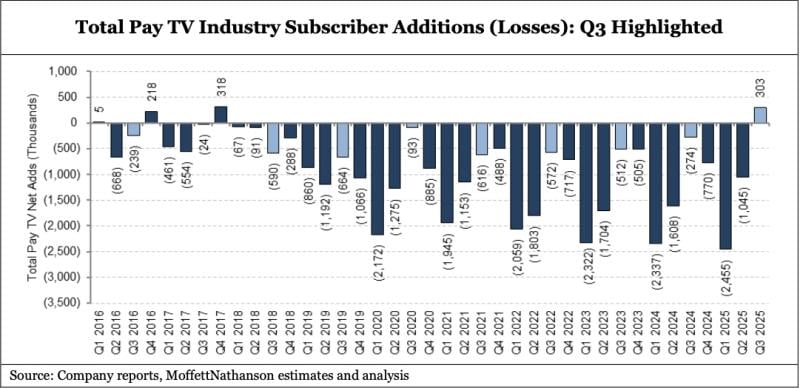
An anonymous reader quotes a report from Ars Technica: On Monday, research analyst MoffettNathanson released its "Cord-Cutting Monitor Q3 2025: Signs of Life?" report. It found that the pay TV operators, including cable companies, satellite companies, and virtual multichannel video programming distributors (vMVPDs) like YouTube TV and Fubo, added 303,000 net subscribers in Q3 2025. According to the report, "There are more linear video subscribers now than there were three months ago. That's the first time we've been able to say that since 2017."

In Q3 2017, MoffettNathanson reported that pay TV gained 318,000 net new subscribers. But since then, the industry's subscriber count has been declining, with 1,045,000 customers in Q2 2025, as depicted in the graph [here]. The world's largest vMVPD by subscriber count, YouTube TV, claimed 8 million subscribers in February 2024; some analysts estimate that number is now at 9.4 million. In its report, MoffettNathanson estimated that YouTube TV added 750,000 subscribers in Q3 2025, compared to 1 million in Q3 2024.

Traditional pay TV companies also contributed to the industry's unexpected growth by bundling its services with streaming subscriptions. Charter Communications offers bundles with nine streaming services, including Disney+, Hulu, and HBO Max. In Q3 2024, it saw net attrition of 294,000 customers, compared to about 70,000 in Q3 2025. Other cable companies have made similar moves. Comcast, for example, launched a streaming bundle with Netflix, Peacock, and Apple TV in May 2024. For Q3 2025, Comcast reported its best pay TV subscriber count in almost five years, which was a net loss of 257,000 customers.
"Traditional pay TV -- i.e. cable and satellite -- still declined quarter over quarter in Q3, but again, by less," noted SteamTV Insider. "The [year-over-year] rate of attrition dropped from -12.4 percent to -10.2 percent over 12 months."

MoffettNathanson added: "Yes, Q3 saw a positive net add number for [pay TV for] the first time in eight years, but that positive result came in the year's seasonally strongest quarter. We're not yet close to seeing the category actually grow again..."
The Courts

Netflix Faces Consumer Class Action Over $72 Billion Warner Bros Deal (reuters.com) 49

Netflix's $72 billion bid to buy Warner Bros Discovery has triggered a consumer class action claiming the merger would crush competition, erase HBO Max as a rival, and hand Netflix control over major franchises. Reuters reports: The proposed class action (PDF) was filed on Monday by a subscriber to Warner Bros-owned HBO Max who said the proposed deal threatened to reduce competition in the U.S. subscription video-on-demand market. "Netflix has demonstrated repeated willingness to raise subscription prices even while facing competition from full-scale rivals such as WBD," the lawsuit said. [...] The lawsuit said the Warner Bros deal would eliminate one of Netflix's closest rivals, HBO Max, and give Netflix control over Warner Bros marquee franchises including Harry Potter, DC Comics and Game of Thrones. On Monday, Paramount Skydance launched a $108 billion hostile bid to buy Warner Bros. Discovery with an all-cash, $30-per-share offer.

Slashdot Top Deals